
by Lydia Somerville | Photography by Angie Seckinger
When Wayne and Gloria Knox called on the Washington, D.C., design firm of Solis Betancourt & Sherrill to renovate and decorate their newly purchased home in Arlington, Virginia, they tasked the team with two major objectives: to rescue the 1950s interior of the Tudor-style house and to provide an appropriate backdrop for their extensive collection of French and Swedish antiques. “We’ve been friends with Wayne and Gloria for 25 years,” says Paul Sherrill, “and Wayne has a great relationship with several fine antiques dealers in the area, such as Marston Luce, Tone on Tone, and DHS, among others. As a result, his collected pieces work beautifully in the home.”
The house was built in the 1950s and showed its age with a choppy layout, aggregate floors, and paneled walls. Wayne, who worked as an engineer for the U.S. Navy before becoming a residential developer, proved to be a dream client. Not only did he buy in to the design firm’s ideas for raising ceilings and opening rooms, he knew the engineering possibilities. “We’d suggest a skylight, and Wayne would say, “Let’s open the whole ceiling,’ ” recalls Sherrill. One such solution greets visitors as soon as they step in the front door. A glass panel in the entry floor allows light from the skylight above it to pass through into the once-dark lower level.
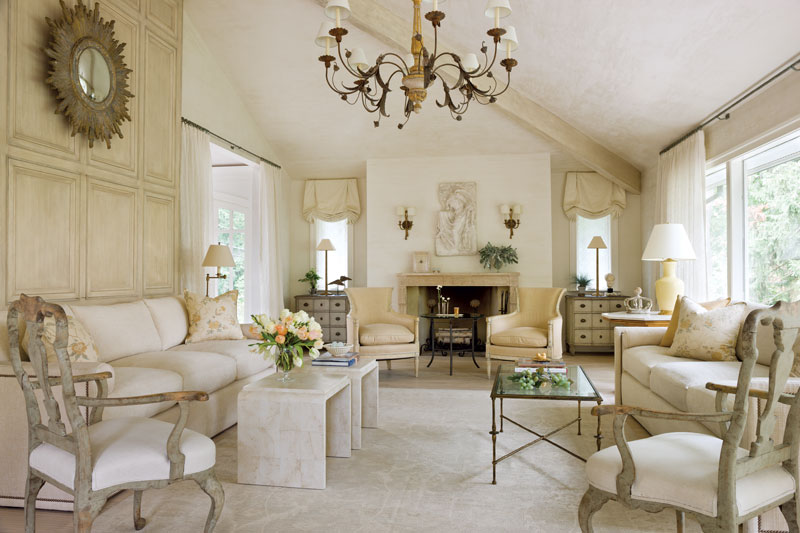
Taking cues from the couple’s furniture collection, Sherrill and design partner José Solis Betancourt worked with decorative painter Lenore Winters to imbue the house with finishes that complement the painted antiques. “Venetian plaster walls give the house a masonry feeling,” explains Sherrill.

With the statement pieces already in place, the designers worked to provide functional elements that would make the house livable. All the upholstered furniture came from their workshop and provides a weighty counterpoint to leggy, painted pieces. In the living room, the paneled wall behind the sofa houses HVAC, television cables, and trunk lines. Winters gave the wood a lush, decorative finish based on one of the painted antiques.
Solis Betancourt and Sherrill originally intended the dining room to be a family room but quickly realized the couple would never use the living room if they had an alternative gathering place. Instead, they opened the room to the kitchen and created a space for entertaining with the airy atmosphere of a conservatory. “The dark dining table anchors the dining room and alleviates the ‘everything is painted’ effect,” says Sherrill.

In the kitchen, a rich wood table serves a similar purpose as a counterbalance to a handsome painted chest and chairs. The designers installed trapeze-style pendants which can remain high for overall radiance or can be pulled down to create more intimate pools of light. “A few quiet, contemporary details that are quite functional give the house modern comfort among all the antiques,” says Sherrill. It’s these expertly integrated elements that allow the couple to enjoy today’s conveniences in a home that celebrates the best of the past.