
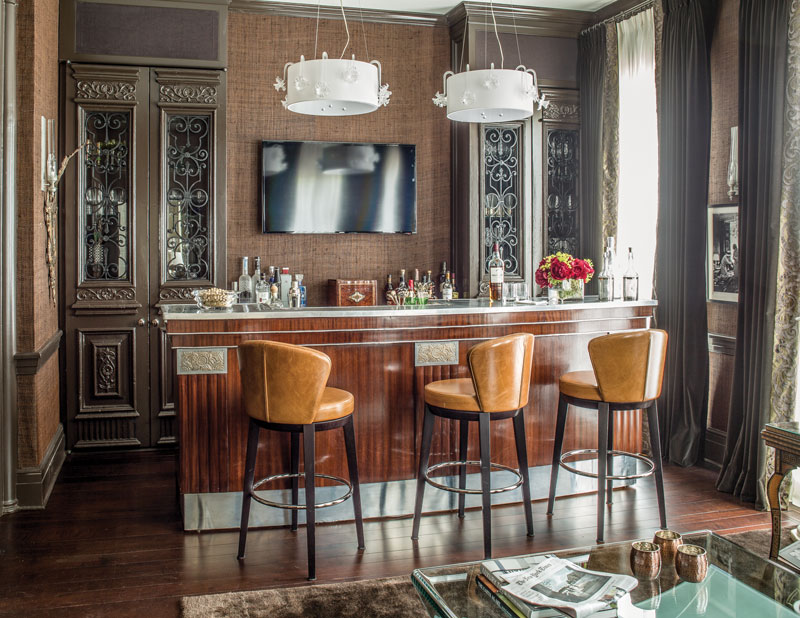
The fun begins in the entry hall with a sextet of bright artwork that greets visitors from the stair landing, while a Greek key-patterned runner plays off the geometry of the black-and-white marble floor. In the long living room, Hajj established two seating areas, each with a distinct vibe. At one end, European tradition reigns with damasks, tufting, and a gilt chandelier. The other end brings contrast with a spicy mix of textiles and a Turkish pendant light. “I’m always enamored by different cultures,” says Hajj, “and the Mediterranean Syrian fixture felt great with the gilded Italian chandelier.”
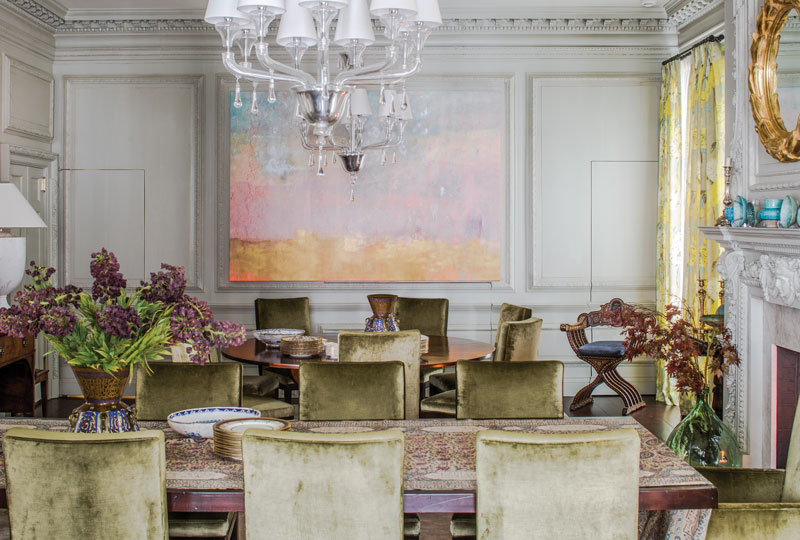
In the dining room, architect Dale Overmyer preserved the elaborate moldings. “They were originally imported from Europe, and the room was sized to fit them,” says Overmyer. “The woodwork had been dark brown. We agreed that a lighter, monochromatic paint would allow us to preserve the heritage of the room in a contemporary way.” Because the clients entertain often—both intimate groups and larger gatherings—Hajj furnished the room with two tables, one round and one rectangular, to accommodate either crowd. An antique Persian textile used as a tablecloth is a signature Hajj trait, which she extends to her treatment of beds.