Text Margaret Zainey Roux
Photography Stephanie Welbourne Steele | Styling Melissa Sturdivant Smith
Despite its neoclassical motifs, Josiah Wedgwood’s iconic colored stoneware looks anything but antiquated in today’s interiors.
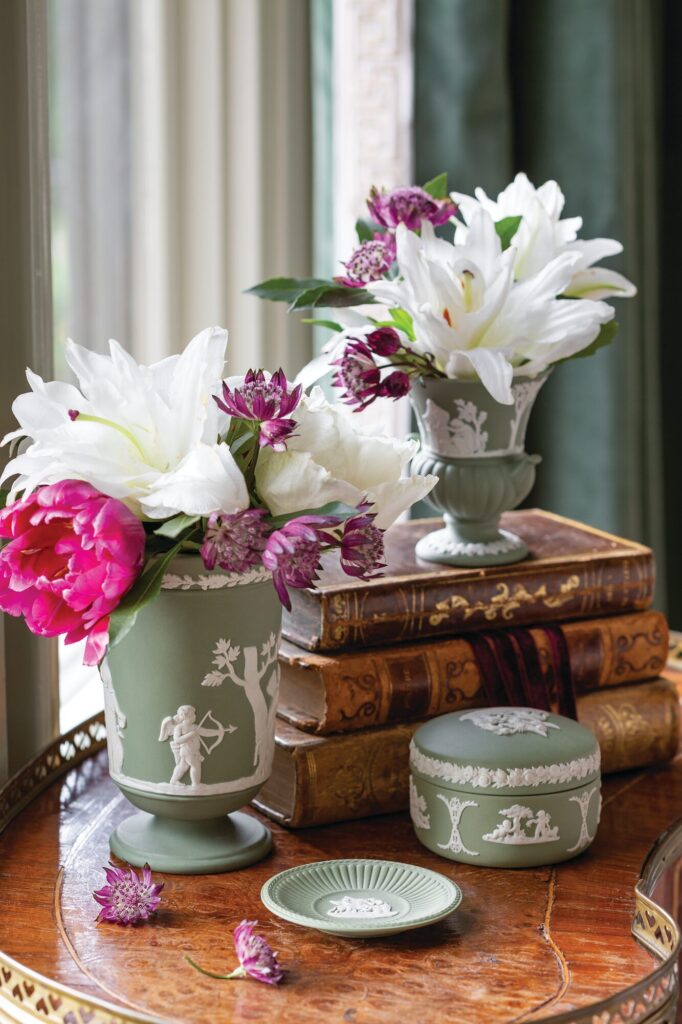
For more than two centuries, jasperware has been widely known for its rich colorways, intricate reliefs, and classic elegance. What is less known, however, is that the artisanal stoneware was considered cutting-edge in its time. Its story begins in the 1770s, when English master potter Josiah Wedgwood introduced unglazed stoneware that was unlike anything the world had seen at the time. His formula (that remains confidential to date) was designed to mimic the smooth texture, durability, and high density of jasper, the natural mineral that it was named for.
Inspired by Antiquity
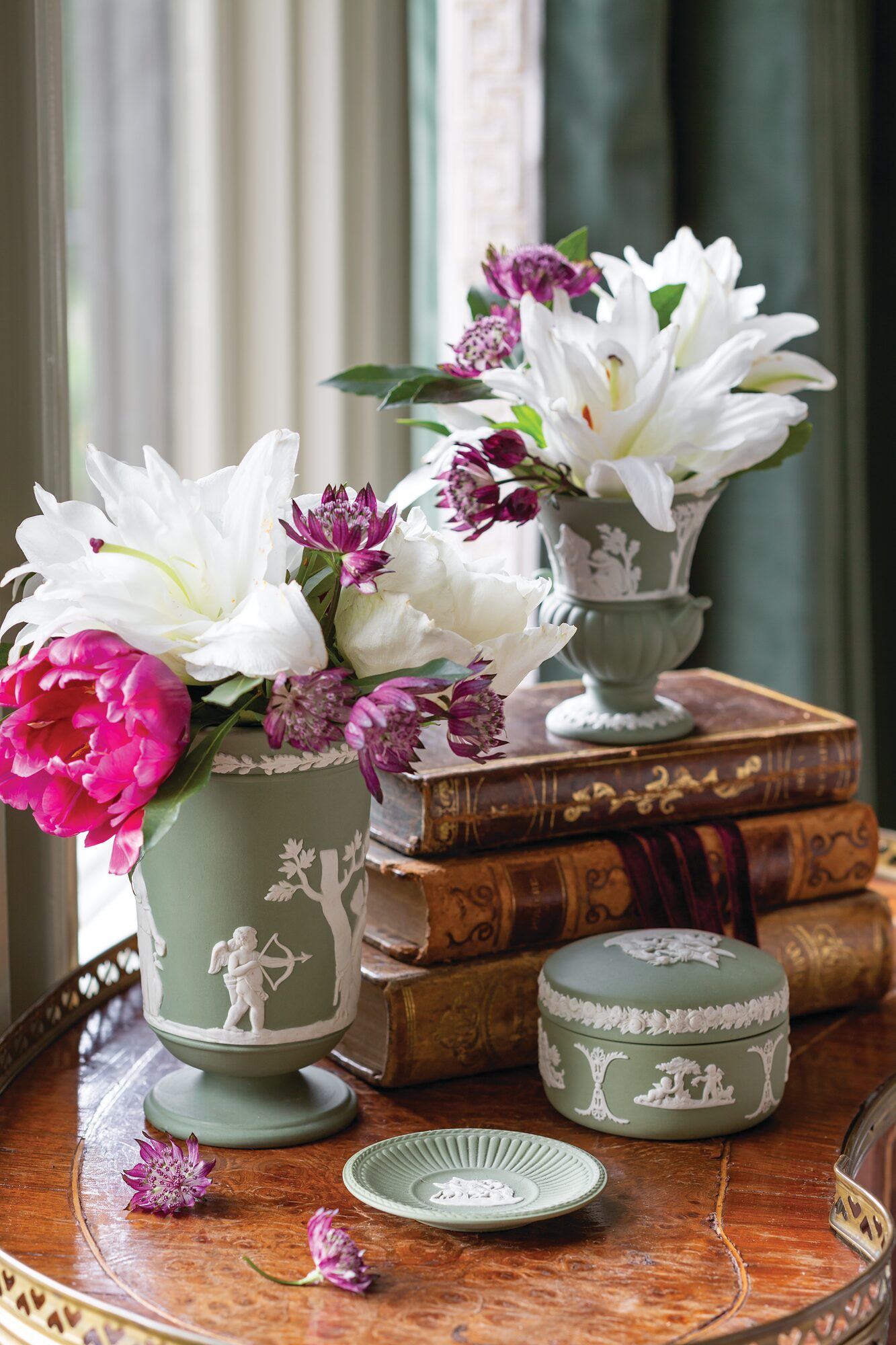
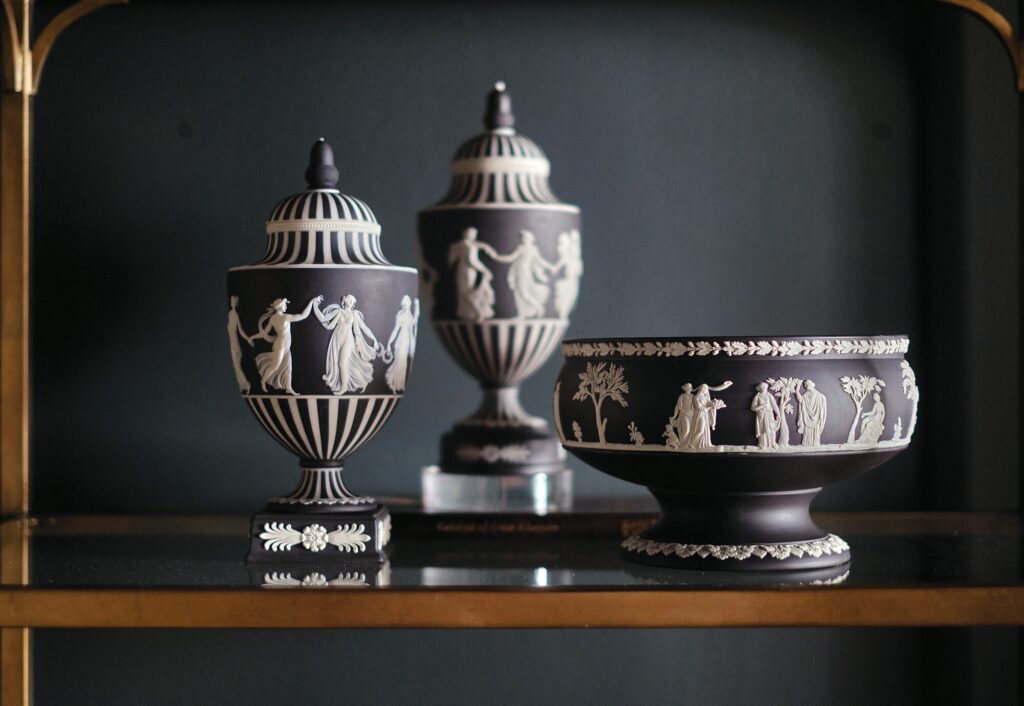
Wedgwood’s vases and urns, dishes and plaques, and other decorative accessories featured intricate relief work depicting Greek and Roman motifs. These cameos, floral garlands, dancing muses, and mythological scenes were inspired by the archeological discoveries at Pompeii and Herculaneum and echoed society’s renewed interest in antiquities. Each relief was cast separately and then meticulously applied by hand to the objects in saturated shades of blue, lilac, black, sage green, and cobalt. Other colors such as white and yellow were also introduced, but due to unpopularity, they were not produced for very long.
How to Identify Antique Jasperware
According to decorative art historians, antique jasperware is characterized by its smooth, consistent matte finish and sharply defined relief work that has been integrated seamlessly into the body of the object rather than heavily glued to its surface. The earliest pieces of jasperware have become increasingly rare and, if found, can be difficult to authenticate without documentation but can be identified if their impressed Wedgwood markings are clear. These markings evolved over time, so they are helpful in establishing an age range. The most current stamp reads “Wedgwood Made in England” and has been used since the 1970s.
As with any antique, condition counts, therefore the most prized pieces boast consistent coloring and minimal restoration. Many Victorian, Edwardian, and early-twentieth-century jasperware can still be found on the market, making them more accessible.
Jasperware at Home
Collectors and interior designers alike appreciate these pieces for their historical significance and for the extra polish they bring into an already well-appointed room. A pair of classical urns can lend architectural gravitas to a mantel, while a grouping of small boxes, cachepots, and covered jars can bring style and sophistication to a coffee table or bookshelf.
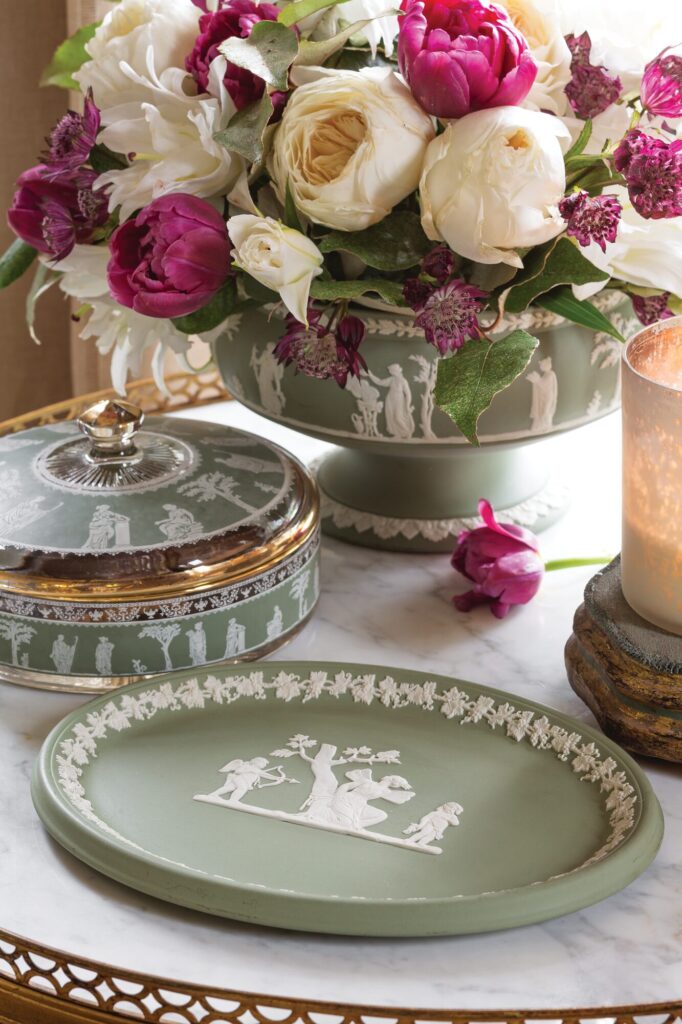
In an era increasingly defined by trends, the appeal of antique jasperware endures by proving that true elegance is never merely decorative—it is a meaningful celebration of craftsmanship, history, and classical proportion.
Need to Know
Replacements’ Marketing and Media Relations Manager, Keith Winkler, talks jasperware today.
What is currently the most popular color?
Cream-on-lavender remains the most popular and prevalent combination. Interestingly, lavender isn’t exactly lavender but rather the company’s signature “pale blue.” Calling it lavender merely helps distinguish this particular shade of blue from the many other blues that were developed over the years.
What are some of the most valuable pieces that you’ve encountered?
We’ve seen jasperware tea services commanding $7,000–$8,500 upward and individual pieces like a Portland vase sell for around $5,500. Perhaps the most extraordinary piece we have come across is a 10-arm jasperware chandelier in cream-on-lavender. Its scale, form, and function make it particularly remarkable and showcase the diverse range of Wedgwood’s offerings throughout the centuries.
Are there particular markings to look for that prove the authenticity and age of a piece?
The stamped Wedgwood mark can help establish authenticity and age, although it should always be considered alongside the piece’s form, decoration, color, and construction. Authentic Wedgwood is characteristically marked WEDGWOOD, not “Wedgewood,” with an additional “e.” The evolution of the mark can also provide useful chronological clues. Pieces simply bearing WEDGWOOD generally predate 1891. The addition of “ENGLAND” began in 1891, while the wording “MADE IN ENGLAND” appears from 1908 onward. By the mid-20th century, a two-digit date code was introduced, with numbers such as “59” indicating production in 1959. Later examples may also be impressed with letters or numbers relating to production batches, potters, or manufacturing periods.