
Text: Tiffany Adams
Photos: NativeHouse
When designer Lori Paranjape began making selections for this Tennessee couple’s vacation home, she didn’t have to dig too deep to find insight. Their daughter, Caroline Schaad, was working as a designer at her firm. “Sometimes we wonder if a client will love what we’ve picked or if they’ve seen it before, and we didn’t have to because we had Caroline on our team,” Paranjape says.
A North Carolina Vacation Home That Marries Mountain Charm and Modern Design
A North Carolina Vacation Home That Marries Mountain Charm and Modern Design

A North Carolina Vacation Home That Marries Mountain Charm and Modern Design

A North Carolina Vacation Home That Marries Mountain Charm and Modern Design

A North Carolina Vacation Home That Marries Mountain Charm and Modern Design

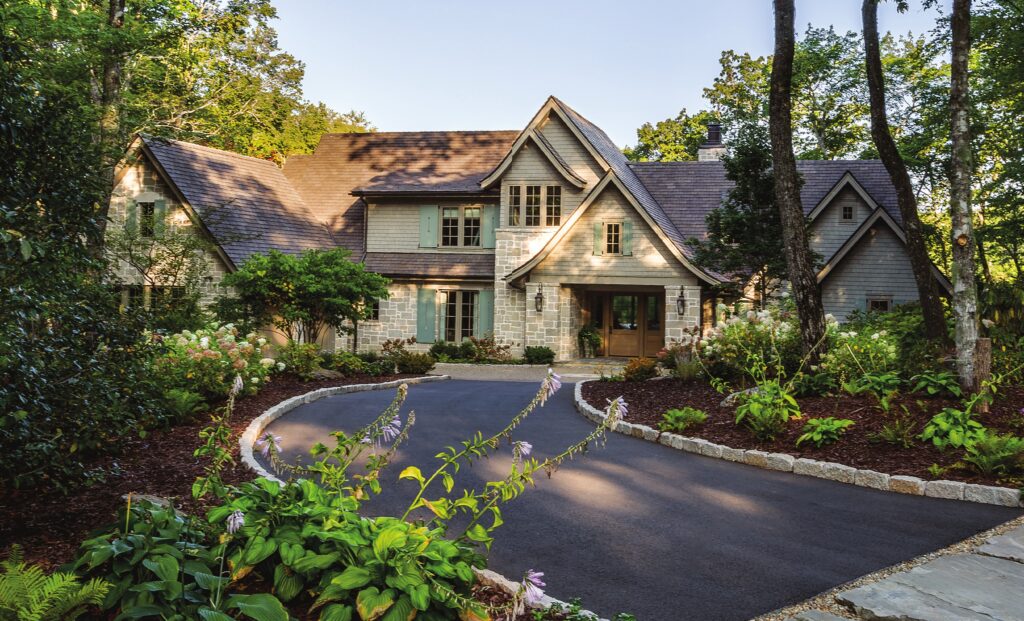
Both Schaad and her mother had long admired the Nashville-based designer’s aesthetic and were excited to bring her expertise to the construction of the family’s mountain house in High Hampton Resort in Cashiers, North Carolina. From the start, they wanted to embrace the Blue Ridge Mountains setting and create a haven where the entire family, including in-laws and grandchildren, felt comfortable.
Working with Jim Robinson of Design South Builders, a plan formulated for the three-level, five-bedroom home that includes an attached guesthouse (or “cabin” as the family refers to it). “Jim knows the mountain and the lay of the land so well, so he could say, ‘These trees stay because of the shade, and these trees go because of the view,’” Paranjape explains. As both the architect and builder, Robinson had a vision for personalization coupled with the experience of building in the area that allowed him to bring the plans to life. He notes that this dual capability “provides flexibility, as well as the freedom to imagine a truly custom home—from the shape itself to the interior artisan features.”
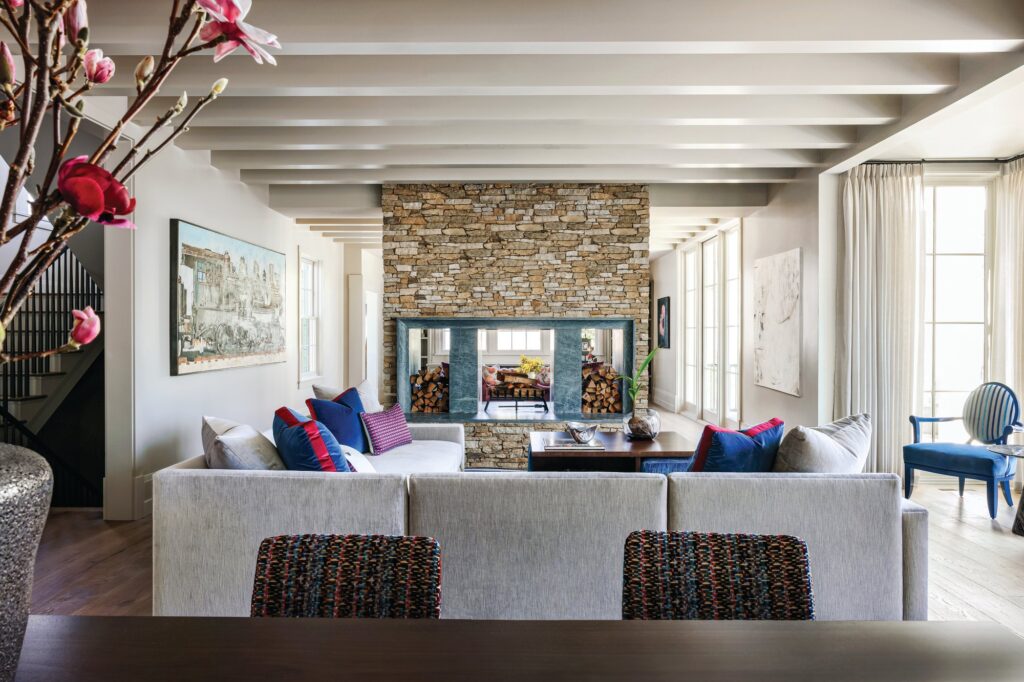
For her part, Paranjape took the approach she takes with all clients by considering their lifestyle and thinking about everything from how they entertain to how they relax. “They frequently talked about their vision for a cozy Thanksgiving gathering place,” she says. To this point, she sought to create spaces that balance high style with comfort through textures and layering—a thread she notes runs throughout the home. “While all of my clients appreciate beauty, they really, really appreciate comfort,” she says. This extends beyond fabrics and chair forms to spatial planning. For example, in the kitchen, gracious square footage was thoughtfully allotted to provide space for eight people to prep, cook, and clean without being in one another’s way.
Many of the materials also speak to the setting. “When you picture a mountain home, you might think antlers and fur, but we wanted to subtly bring in nature,” Schaad says, pointing to features like the branch-inspired light fixture in the living room and white oak paneling in the foyer. “This house was a push for my parents. It’s more casual to go along with the mountain setting, so it took a minute for them to get used to those elements,” she adds.
Robinson notes that a number of local artisans were brought on-site for these features, including the custom metalwork, fluted cabinetry, marble fabrication, and plaster finishes. The theme carries into the home’s most private spaces. Of the primary bedroom, Paranjape says, “The palette is disciplined, so we flexed our muscles with texture again.”
Volume also plays heavily into the scheme with a canopy bed feeling at home in a space with 20-foot ceilings and seemingly unending views of the mountains. Additionally, a downstairs bunk room can sleep up to eight comfortably. “The thought here was, we’ve created this beautiful house—let’s fill it up,” Paranjape says. “It should feel like you are piled in the beds and whispering at night,” she adds.
Because it is a vacation home, the designer also considered practicality for guests, opting for fewer walk-in closets and more wardrobes, where overnighters can tuck away a suitcase and hang a few articles of clothing. “When you are in your happiest place, you feel all the weight lifted from your shoulders,” Schaad says, adding that her entire family finds solace and inspiration at the retreat. “We named the house Happy Hideaway and even had it stamped into the rocking chairs,” she says. “We did all that before we ever moved in, but it’s funny how the name rings true now.”