Few types of ceramics have managed to elicit as much enthusiasm and produce as much confusion as majolica—the colorful, Victorian-era pottery which continues to brighten homes today. But to better understand what makes majolica special, one must first differentiate it from another type of pottery that bears the same name, maiolica, and the distinctions between the two are much more than a matter of semantics. The older of the two varieties, maiolica dates back to the fourteenth century, when Italy began to import Spanish pottery by way of Majorca, the Spanish trading port from which the Italian term maiolica took its name. Intrigued by the pottery’s lustrous, tin-oxide glaze that preserved the color intensity of the underlying painted decorations, Italian craftsmen began to produce their own version of glazed, brightly hued ceramics, which frequently depicted popular Renaissance themes such as Greek mythology and ancient history.
Majolica, which is considered the better known of the two, did not come into being until the nineteenth century, and although it adopted its name from maiolica, it owed its existence instead to the Industrial Revolution. Developed by the English pottery factory Minton and first introduced in 1851 at the Great Exhibition at London’s Crystal Palace, majolica captured the public’s attention thanks to both Minton’s proprietary colored lead glazes, which gave the earthenware a bold, eye-catching appearance, and the forms themselves, whose relief surfaces and intricate shapes were marvels of manufacturing. Because pieces were made using molds, majolica could be mass-produced, thus making it affordable for England’s increasingly prosperous and growing middle class. Colorful and accessible, majolica became a hit and eventually dominated the pottery market, both in Europe and America.

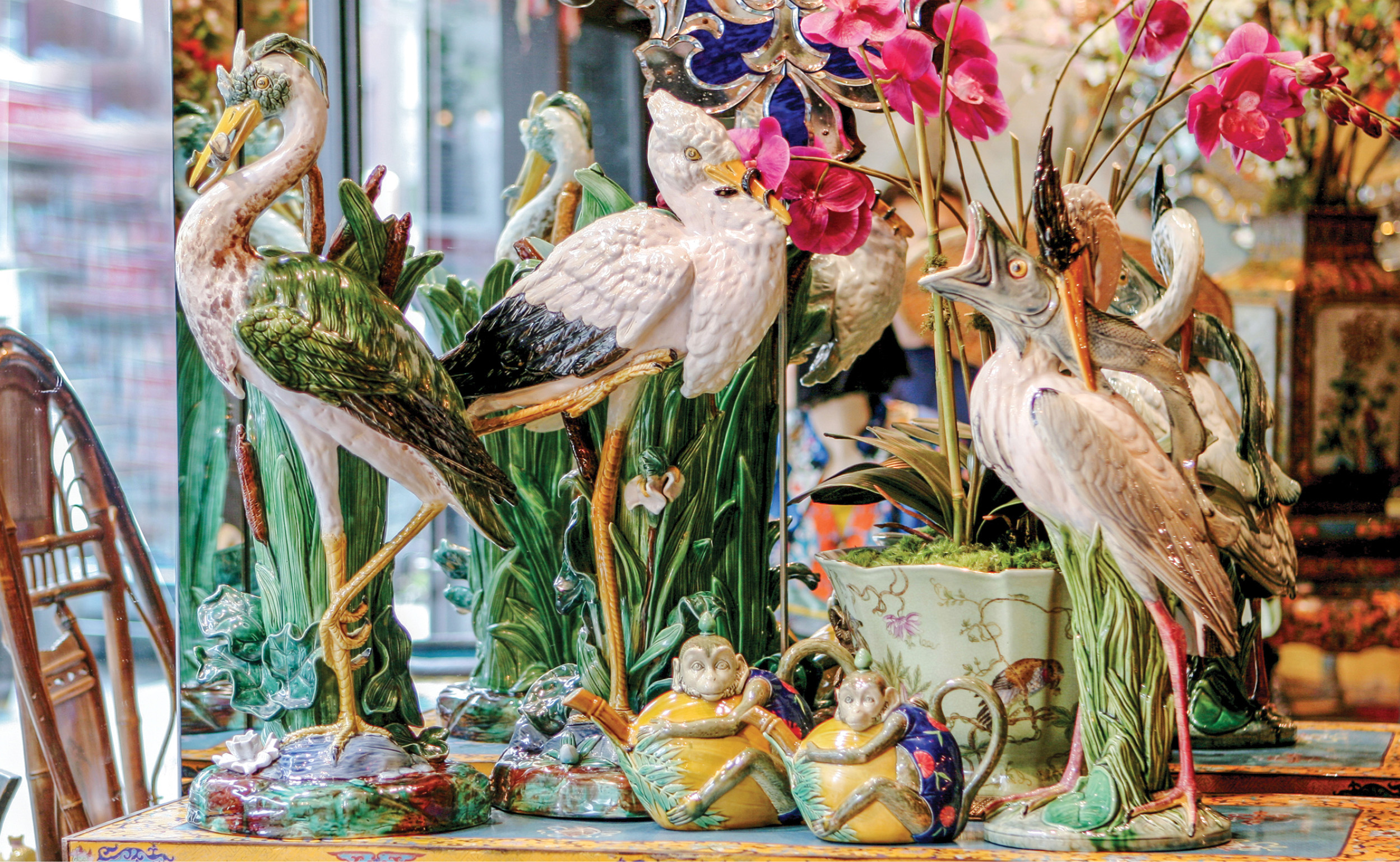
What is remarkable about majolica is how its wide-ranging designs managed to reflect the full spectrum of Victorian-era culture. Late-nineteenth-century English architecture and art were influenced heavily by historical revivals, hence those majolica pieces designed to imitate Italian Renaissance or Gothic styles. Then there was the burgeoning interest in science, especially Darwinism, which in turn spawned majolica pieces decorated with monkeys. But the genre of majolica that was most popular was that which mimicked nature, something Victorian society increasingly pined for in reaction to the Industrial Revolution. There were plates molded and colored like leaves, vases shaped like coral-encrusted nautilus shells, and teapots that resembled turtles. Incidentally, many majolica designers adhered to the theory of “fitness of purpose,” meaning that a piece’s form should reflect its function. This explains why majolica asparagus plates were made to look like bundles of asparagus and game pie dishes were often embellished with hares or quail.

The variety of goods produced in majolica was also staggering. Because nineteenth-century dining was so elaborate, a variety of tableware was required, and for many Victorian households, that meant purchasing majolica oyster plates, soup tureens, compotes, and cheese domes. Elsewhere in the home, one could indulge in colorful majolica tiles, wall brackets, vases and jardinières, umbrella stands, and flamboyant garden seats, which were typically coupled with another Victorian-era design trend: winter garden rooms and conservatories. Majolica was even used outdoors, where large garden ornaments and fountains provided colorful accents.
Ultimately, what made majolica so popular in the first place proved to be its downfall. Mass-production eventually resulted in such inferior and watered-down designs that people’s interest in majolica began to wane, and by the early twentieth century, majolica, not to mention other emblems of the Victorian age, seemed passé. Since the 1970s and 80s, when the pottery experienced a revival in interest, majolica collecting has remained brisk, which is hardly surprising considering the pottery’s colorful history.
 need to KNOW
• Although Minton is credited with developing majolica, its popularity encouraged other English pottery factories to follow suit and manufacture it, including Wedgwood, Royal Worcester, and George Jones. In France, major producers included Sarreguemines and St. Clément, while in America, Griffen, Smith & Hill grew to become the country’s largest manufacturer of majolica.
• Majolica made by high-quality manufacturers, such as Minton or George Jones, can usually be identified by their makers’ marks, which were stamped, printed, or embossed on the piece. Lesser-quality examples often, but not always, lack makers’ marks.
• When buying majolica, “look for good clean marks on sturdy, good quality pieces that are glazed both on the interior and the exterior,” says Mark A. McBride of Moss Antiques in New Orleans, which is owned by Keil Moss and family. “The pieces should have good weight and, most importantly, be in good condition.”
• According to East Coast designer Carol Vargo, who is also the proprietor of Gray Antiques and an avid majolica collector, “Prices for majolica can range from a few hundred dollars for a plate to the mid-hundreds or low-thousands for pitchers, platters, tureens and matching sets, depending on the maker, time period, size, and detail of the piece.” Matched sets, such as dessert plates or tea sets, are particularly desirable, says Vargo.