
Charleston entertaining and etiquette expert Suzanne Pollak says it best: “We are wallflowers and proud of it.” Those words open a chapter in her book about gracious living, The Charleston Academy of Domestic Pursuits: A Handbook of Etiquette with Recipes. She’s talking about (or from the perspective of) sideboards, the iconic pieces of dining room furniture that preside over a formal table and chairs. “In many houses, it’s the most expensive piece of furniture,” Pollak says. “Young people may use a chest of drawers for a while, but it’s too clunky. The sideboard’s value as a serving and storage piece becomes clear, and it marks you as an adult with refined tastes.”
Versions of the sideboard have been around for centuries in the form of long boards atop trestles from which food and drink were served and silver pieces displayed. But in the mid-18th century, the table became a presence as decorative and interesting as the treasures it supported. “Its construction reflects the evolution of society and how people lived,” says David Lindquist of Whitehall at the Villa Antiques in Chapel Hill, North Carolina.

As houses grew in size and rooms in number, the functional serving table became a symbol of the wealth of its owner. Most were made of mahogany, inlaid with satinwood and brass, and designed with drawers and later with cabinets that stored silver, crystal, and linens. In addition, with space to set up a buffet, the sideboard became the do-it-all server that made dining an experience.
There is some disagreement about who designed the first sideboard. When English architect Robert Adam was designing furniture for the houses he created in the 1760s, he incorporated the imagery he had discovered in the excavations of classical ruins in Rome and Pompeii. His earliest sideboards were large and fairly opulent with pedestals at either end topped by urns that held silverware in one and dispensed hot water for cleaning dishes in the other. The brass rails rising from the top of many sideboards had sheer fabric hanging from them to shield expensive walls and wallcoverings from the potential splatter of a soup or sauce.
Working just a few years after Adam, Thomas Sheraton and George Hepplewhite both created design books that have inspired sideboards ever since. Six tall legs created a serving height of 34 to 38 inches, and large drawers were lined with felt for silver or with lead for ice to chill wine. The ornate inlay and highly reflective mahogany wood of these 18th-century sideboard designs inspired cabinetmakers in England and the young United States. Sheraton’s and Hepplewhite’s designs are in fact associated with the American Federal period, an interpretation of English Georgian and neoclassical styles that yielded sober, impressive serving tables. Competitors at the time, these two designers influenced one another but also had some unique differences in style. For example, “Hepplewhite and Adam made square, tapered legs. Sheraton’s were often turned and rounded,” says Lindquist.
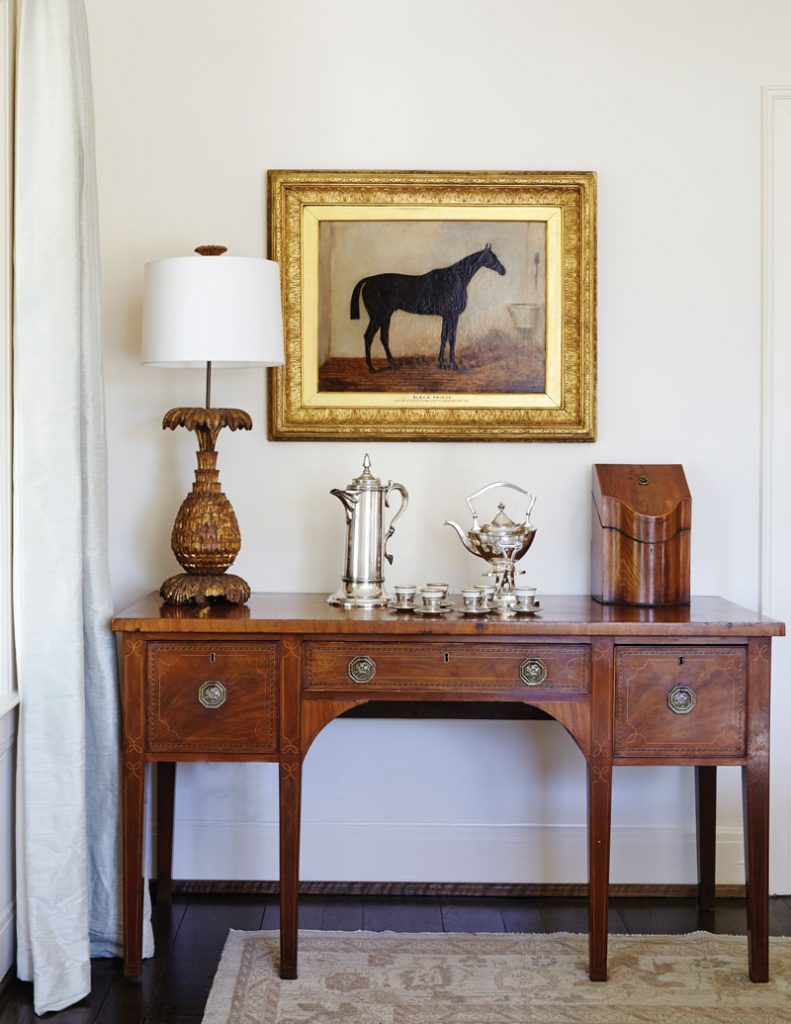
Today, those tables and their offspring give a dining room its grown-up sensibility. Despite the decorating world’s attraction to all things modern, Lindquist has seen consistent appreciation for the sideboard. “It has a great presence—a beautiful surface, a height that nicely anchors a room, and it’s practical for storage and display,” he says. In addition, many of today’s designers enjoy finding new roles for the sidebord, perhaps as a display table or even a bathroom vanity. And they aren’t afraid to mix the centuries-old antique with edgy designs.
According to Charlotte designer Jane Schwab, incorporating an 18th-century-style sideboard into any style of dining room is important. She cites the practicality of this serving table but says what really makes it essential to her work is its ability to make memories. “Think of the great meals and the conversations you have in the dining room. The sideboard is part of that,” she says. Schwab also appreciates its tall stature for more than just function. “It’s nice to have a variation of heights in the space.”
Pollak encourages people to use their fine pieces. “The sideboard is great to hold silverware, but keep your playing cards and jigsaw puzzles in there as well,” she suggests. And she emphasizes the importance of accessories when incorporating a sideboard. “It needs a beautiful painting or a mirror above it—something to reflect the chandelier and candles,” she says. And the piece should be decked with “a silver or ceramic tea set and a big bowl of flowers.”

It’s clear that the sideboard remains as useful, captivating, and beautiful today as it was 200 years ago. Times and tastes change, but the best designs weather every evolution in style and remain eternally desirable.
need to KNOW
HEYDAY OF DESIGN:
mid-18th century to mid-19th century
FAMOUS MAKERS:
These architects and cabinetmakers created the pattern books that have inspired furniture makers from the 18th century to today.
• Thomas Chippendale (The Gentleman and Cabinet-Maker’s Director)
• Robert Adam (The Works in Architecture of Robert and James Adam)
• George Hepplewhite (The Cabinet-Maker and Upholsterer’s Guide)
• Thomas Sheraton (The Cabinet-Maker and Upholsterer’s Drawing-Book)

CHARACTERISTICS:
Mahogany body with ornate satinwood, birch, beech, or sycamore inlay; pedestal sides with an urn on top of six tall legs; two large drawers later replaced by cabinets on either side to hold ice and silver holloware; center linen and silver drawers.
WHAT TO LOOK FOR:
• Most 18th-century sideboards are 26 to 32 inches deep, even 38 inches on some boards. If it’s 22 to 24 inches deep, it may have been cut down to make it shallower, or it may be a reproduction.
• Look closely at where the legs join the body. Look for repairs. Examine to see if the legs look as if they were once stouter. “Cabinetmakers will take heavy legs and taper them to make them more elegant and more appealing to potential buyers,” says Lindquist.
• Look at the back. Tenons should extend through the backboard from all structural dividers.
OTHER INCARNATIONS:
Serving tables in a dining space are not unique to the English and Americans. In other countries and time periods, they may look different or have other names, but they serve the same function. France: buffet or enfilade Italy: credenza Southeastern United States: huntboard or Southern sideboard.