





Text by: Lydia Somerville
Photos by: Angie Seckinger
When Ann Roddy and Jill Johnson brought designer Nestor Santa-Cruz to view their newly purchased house, he quickly went into triage mode. The Cuba-born designer, who had decorated previous houses for the couple and their three children, understood the appeal of the Forest Hills neighborhood, a woodsy, family-friendly area in northwest Washington, D.C. But the house itself, a split-level rancher built in the 1950s and occupied by only two owners, posed several challenges, among them, small windows that didn’t capture the views of the pretty street and a kitchen and bathrooms that were greatly outdated. So Santa-Cruz set about making structural changes that would bring the house into the present without losing the easy comfort of a midcentury split-level.
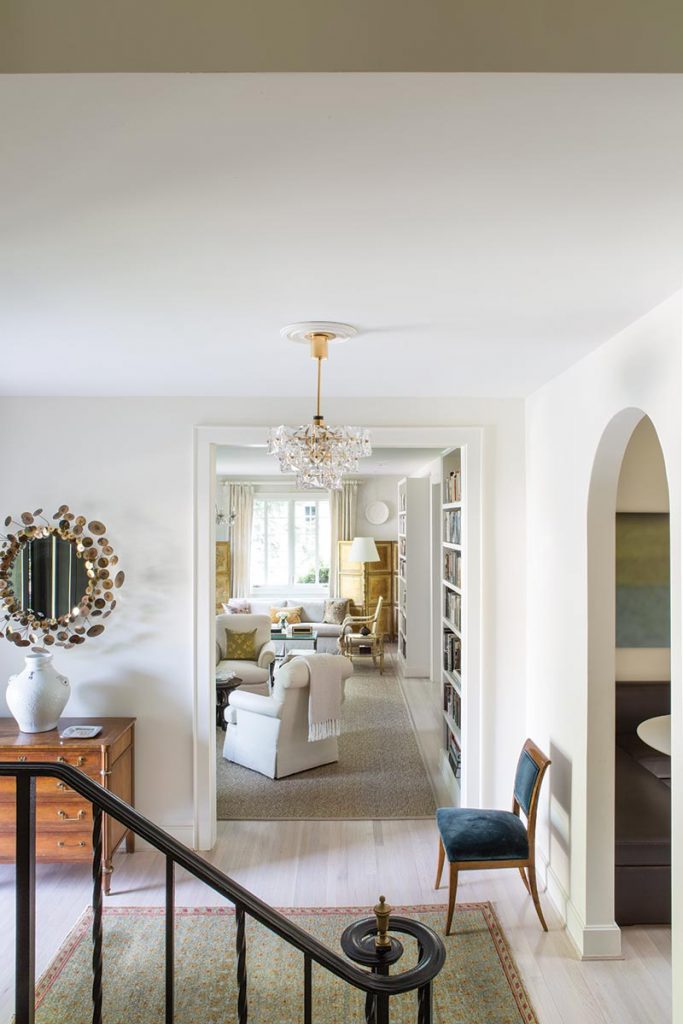
First to go were the small windows and doors, replaced by larger windows—which would allow in bountiful sunlight—and taller door openings. Santa-Cruz bleached the floors to reflect the increase in light, replaced dated woodwork, and enlarged doorways. In the entry hall, a small swing door to the kitchen was opened to an archway, adding the softness of a curve and drawing the eye upward to the high ceiling. “Jill loved the arch idea, and Ann allowed it,” says the designer. “We now think it makes all the difference, as if it were always there.”
Likewise, the opening to the living room was increased from 8 feet to a full ceiling height of 10 feet. The living room itself serves multiple functions. “It is formal and informal at the same time,” says Santa-Cruz.
“It’s a living room, library, and music room all at once.” The clients wanted built-in bookshelves, but the designer balked. “I didn’t want the long and beautifully proportioned room to feel too busy, and I wanted to save some walls for their art,” he says. “But I remembered I was not designing for me.” The trio compromised with shelves that stop short of the ceiling and flank the opening to the dining room, adding symmetry to the off-center space. The living-room walls were covered in squares of handmade paper, a tribute to Santa-Cruz’s design icon, Jean-Michel Frank.
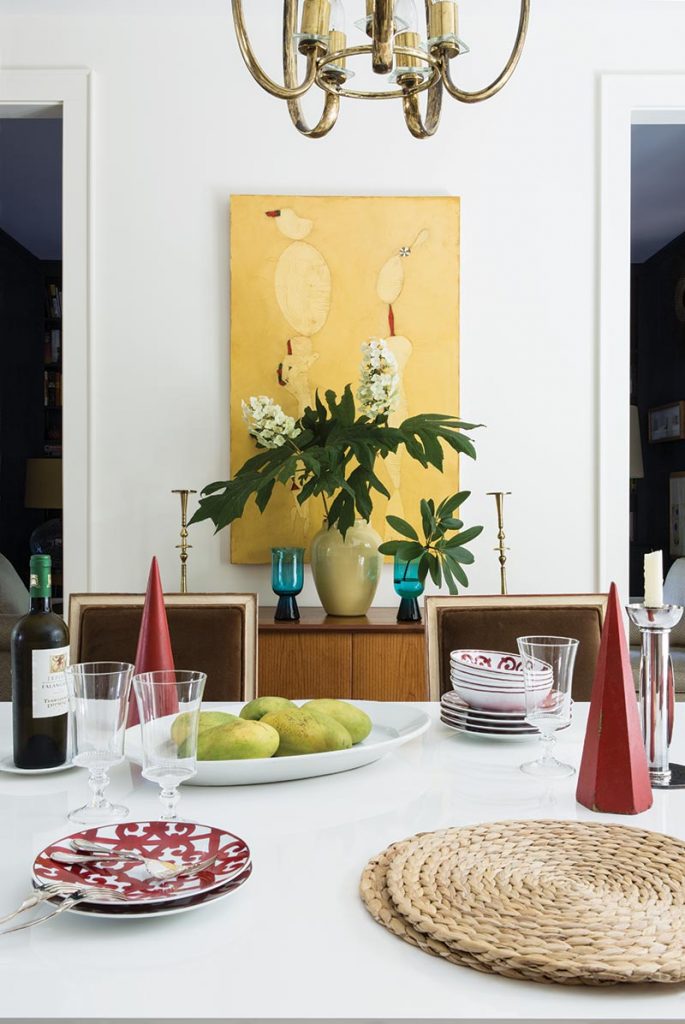
In the dining room, Frank’s influence is abundant. The French minimalist designer of the 1930s and ’40s, credited with creating the Parsons table, was also famous for parchment-covered walls and luxurious but subtle finishes like shagreen and mica. The same understated elegance defines the dining room, where Santa-Cruz surrounded a Parsons dining table with Directoire-style chairs covered in brown velvet. The designer chose to showcase the clients’ figurative art collection in a salon-style display of canvases. A yellow painting with red accents by Mauricio Luengas over the sideboard inspired him to buy the geometric artist’s models and group them on the table as a gift for his clients.
On the ceiling, an abstract gilded mural is a classic Frank finishing touch. By moving the doorway from the dining room into the kitchen—closer to the outside of the house—the designer was able to align it into an enfilade with the doorway into the teal-blue den. Here, Santa-Cruz was able to rescue a typical 1950s den with a jolt of bold color. “One of my favorite Farrow & Ball colors, Stiffkey Blue, brings cohesiveness to the room,” he says, “and it covers the old wood paneling.” And in the kitchen, now visible from the den through the dining room, blue ceramic tile of the clients’ choosing gave the space a bit of color.
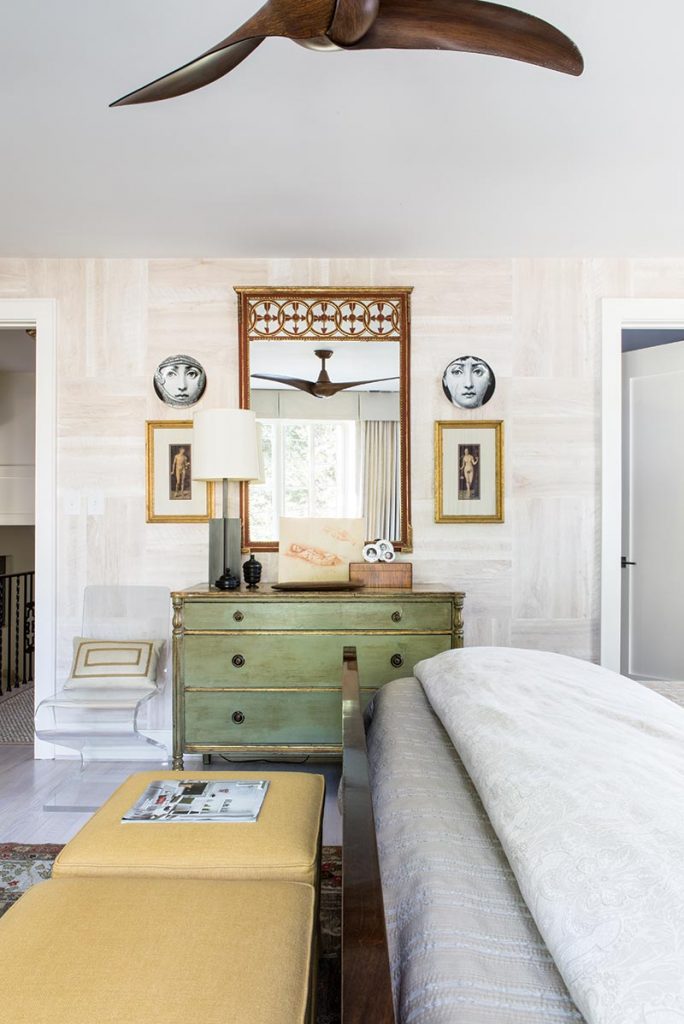
The master bedroom, situated in the treetops, is an oasis of calm and texture. “We enlarged the windows to invite the outdoors in and create the feeling of being in a garden room,” says Santa-Cruz. He also covered the walls in a basketweave of
faux-wood wallpaper for more of that Frank-style restraint. “Jill wasn’t as enamored as Ann was of the treatment,” he says.
“Once it was done, we were all pleased with the effect.” Blackout draperies cocoon the room, and substantial valances added structural definition. Furniture from the clients’ previous home furnished most of the space; the only new addition was vivid yellow stools. The designer suggested the Fornasetti plates on each side of the mirror. “Every room should have a touch of the whimsical,” he says. “It cannot all be so serious.” With smart structural changes, bursts of color, and devotion to the proven principles of a design legend, Santa-Cruz has created a home that is as livable as it is luxurious.