 Text: Jennifer Boles
Known around the world by different names, the Foo dog’s long list of monikers is indicative of its global appeal. Sometimes referred to as “Fu” or “Fo” dog, the Foo dog’s name is a Western derivation of the Chinese word for Buddha, Fo. In China, however, “Shishi” is the preferred term, as it also is in Japan. Regardless of the name used, the Foo dog’s heritage is universally captivating.
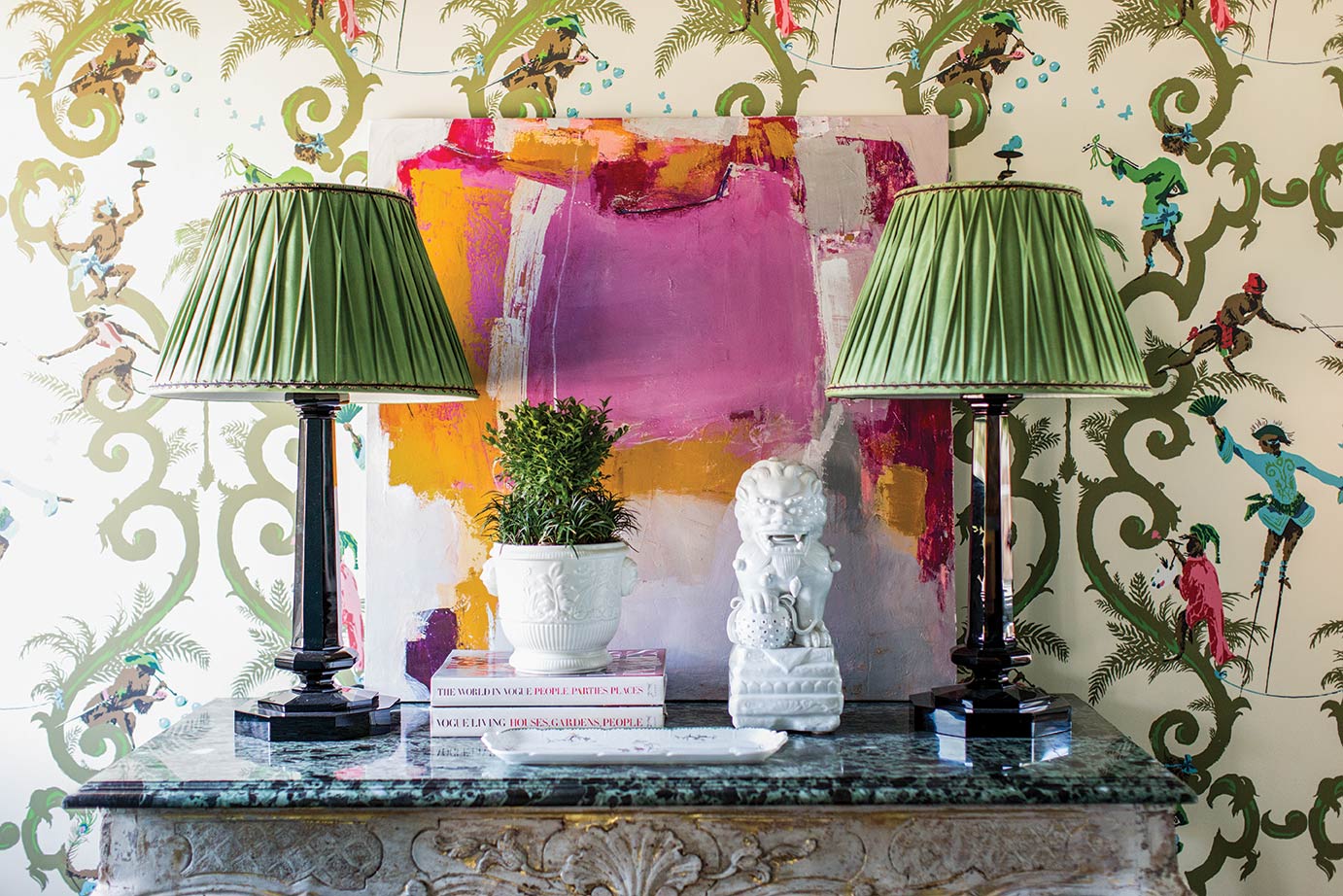
A mythical creature originating in ancient Chinese lore, the Foo dog, essentially a hybrid of a dog and a lion, was thought to ward off evil spirits. First taking shape as large stone sculptures, pairs of Foo dogs were traditionally placed flanking the entries to Buddhist temples, monasteries, and imperial palaces, where they served to protect those sacred sites. Eventually, these guardian lions were adapted by Chinese ceramics makers, whose miniature porcelain versions charmed both Chinese and Westerners alike.
 Whether fabricated in stone or porcelain, Foo dogs are customarily crafted in pairs of males and females, each engendered with distinctive characteristics that have remained consistent over time. Male Foo dogs are usually depicted with one paw atop a perforated ball, which some believe represents the pearl of wisdom. Female Foo dogs, deemed to be nurturers, are almost always accompanied by her cub. Although both forms typically have open mouths, flames were sometimes modeled onto them, making them look more ferocious.
Exported to the West beginning in the 17th century, porcelain Foo dogs, like other Chinese wares, became highly coveted by Europeans.
While some ceramic Foo dogs were merely decorative, others served a purpose. One of the more striking functional versions had a slender cylinder attached to the Foo dog, which was intended to hold joss, or incense, sticks. Diminutive Foo dogs were also crafted by porcelain makers, who affixed them to the lids of jars as both handles and symbolic guardians. The finishes applied to porcelain Foo dogs also varied. Sometimes multicolored or simply blanc de Chine (white), the most desirable shade for many was bleu céleste, a solid turquoise glaze that remains popular today.
Prized for their exoticism, porcelain Foo dogs were sought after by some of history’s most renowned collectors. The early-18th-century Elector of Saxony, Augustus the Strong, whose vast ceramics collection led some to say he suffered from a maladie de porcelaine, counted both colored and plain white Foo dogs among his many treasures.
The Prince of Wales, later King George IV, was also an admirer, having acquired numerous blanc de Chine figures that were displayed at his Royal Pavilion in Brighton. Foo dogs were not consigned solely to royal residences. At Grauman’s Chinese Theatre, Hollywood’s famed movie palace, a pair of large stone Foo dogs still stands sentry outside of its entrance. No matter their size, or sometimes less-than-sacred settings, these ancient legendary creatures have lost none of the power of their charm.
 Need to know:
• A longtime admirer of chinoiserie porcelains, Atlanta designer Mallory Mathison has made Foo dogs a signature feature of her work. “I love how much personality they have. They’re a great sculptural element that works well tucked into bookshelves or china cabinets or even used in tablescapes. Although some say displaying one Foo dog instead of a pair is bad luck, I’m not superstitious about that,” Mathison says.
• Foo dogs come in a variety of colors, including solid turquoise, which Mathison says is the easiest color to find in the marketplace. She also admires multicolored Foo dogs, particularly those in shades of green, yellow, red, or orange. While the most common Foo dog form has the creature stationed on a pedestal, others depict more active Foo dogs, such as those in a walking position.
• The difference between antique and vintage Foo dogs and those more recently produced lies in their details. “New Foo dogs usually lack intricacy, so there is not a lot of detail in the casting. Older examples have more details, such as curls in the Foo dogs’ manes, and they have a lot of depth and dimension,” the designer notes.
• Vintage versions are generally more affordable than antique examples, according to Mathison. “A true 19th-century antique pair can start around $1,000 and go up to close to $3,000, depending on size and condition,” she says. “A good vintage pair sized 12 to 15 inches tall usually costs between $300 and $600.”