
Text: Jennifer Boles
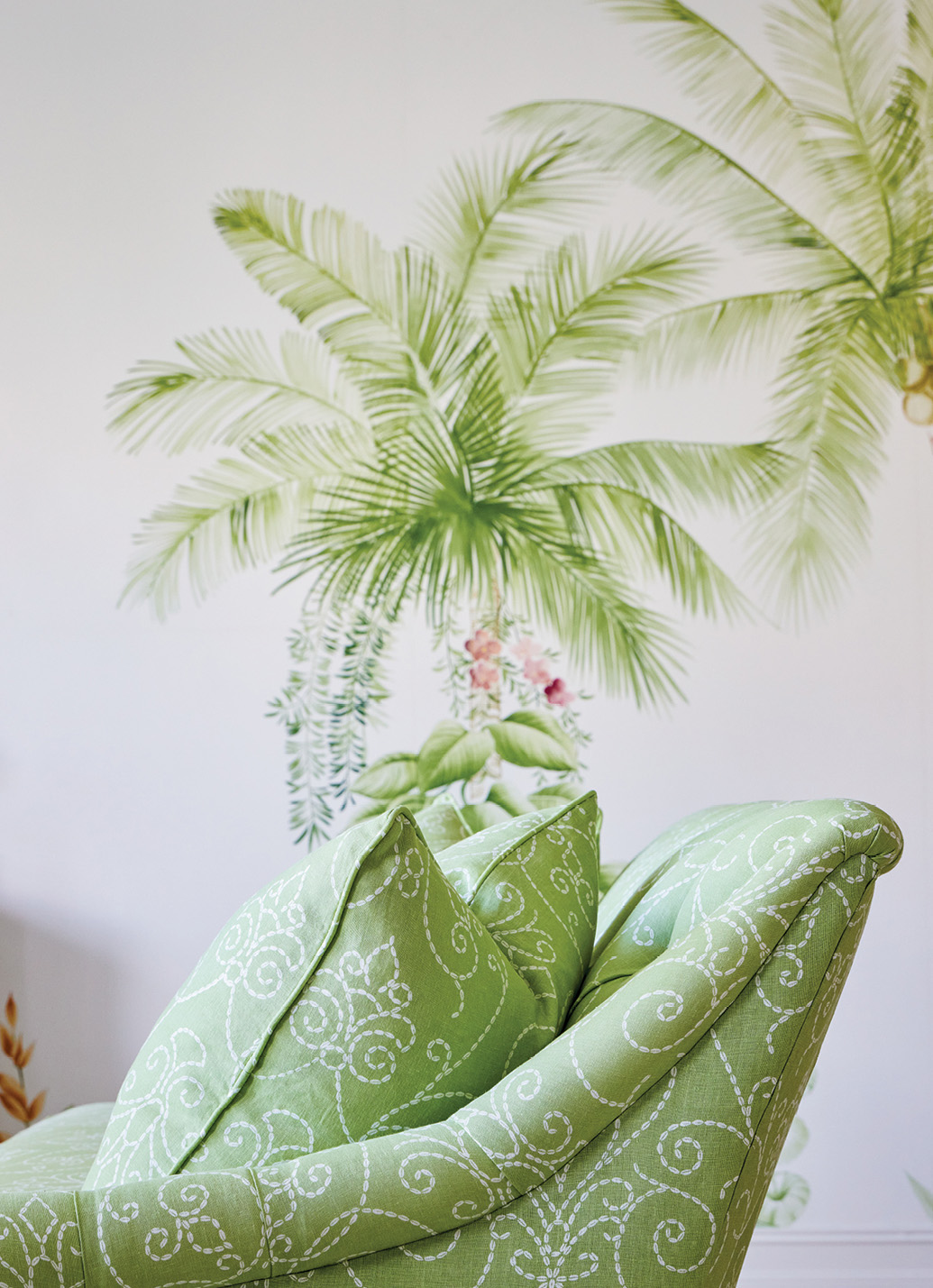
Among the most high-profile features of a coastal landscape, palm trees have become synonymous with a relaxed tropical vibe, so much so that their decorative facsimiles have become equally prominent within many beach and resort interiors. Long ago, however, the palm tree played a far different role, symbolizing instead more serious matters. To the ancient Egyptians, the palm tree represented eternal life, inspiring the construction of stone replicas that were placed among the pyramids. For early Christians, it was the palm frond that became an important part of Christian iconography, representing Jesus’s entry into Jerusalem and establishing a Palm Sunday tradition.
It was not until the first half of the eighteenth century, when the flamboyant rococo and chinoiserie styles dominated European design and art, that the palm tree motif assumed a lighthearted manner, a precursor to the fanciful versions seen today. Befitting the nature-oriented rococo style, the palm tree also satisfied the Western appetite for the exotic. But given their rather rudimentary knowledge of foreign lands, European artists often took liberties when incorporating palm trees into their designs, resulting in sometimes curious pairings. On chinoiserie furnishings such as lacquered screens or tapestries, it was not uncommon for palm trees to appear alongside pagodas and depictions of Chinese tea ceremonies. Palms were also often featured in decorative paintings, even playing host to frolicking animals dressed in formal attire.
 Given their long, lean trunks and their foliated crowns, palm trees were also well-suited as stand-ins for architectural columns. At Sanssouci Park in Potsdam, Germany, Frederick the Great commissioned a garden pavilion known as the Chinese House. Resplendent with mid-eighteenth-century chinoiserie and rococo flair, the pavilion’s most famous feature is arguably its’ gilded palm tree columns that support the structure’s roof. Even when chinoiserie and rococo were no longer the height of fashion, palm trees continued to grace some lavish interiors. At King George IV’s Royal Pavilion in Brighton, England, a stylistic mash-up that included onion domes on the exterior and Chinese-inspired interiors, iron columns shaped and painted to emulate leafy palm trees enliven the otherwise sober-looking kitchen.
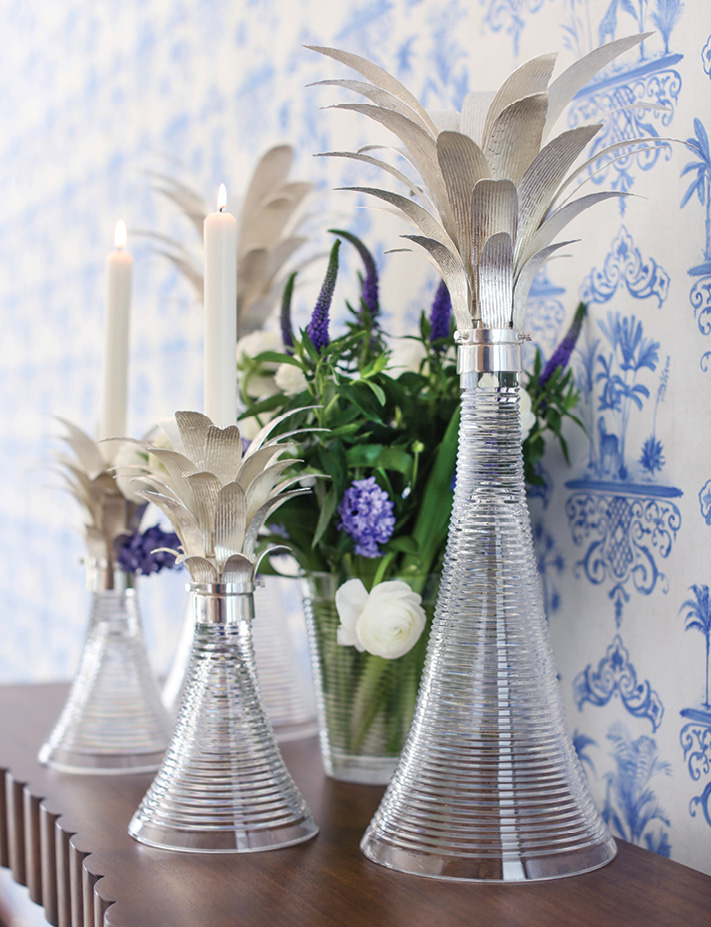
While actual palm trees in pots were considered de rigueur for Victorian-era interiors, it was the chalky-white plaster versions that took the design world by storm in the 1930s, providing a much-needed decorative escape from the Depression. Thanks to the handiwork of French furniture designers Serge Roche and Emilio Terry, plaster torchères and table bases shaped like palm trees were embraced by a slew of designers, including Syrie Maugham in England and the American decorator Frances Elkins. Although today typically relegated to beachy environments, the palm tree in its myriad forms continues to add an insouciant touch to interiors, no matter their location.
need to KNOW
• According to Palm Beach designer Cece Bowman, palm tree decor is a natural fit for coastal interiors, benefiting rooms in multiple ways. “Palm trees are a wonderful nod to tropical locations. As an added bonus, they can also provide height to a room, serving more than one function,” she says. Bowman suggests thinking outside the box when introducing the motif indoors. “I love incorporating palm details in unexpected ways, thinking beyond wallcoverings or textiles. This is why I created the Coco Palm mirror in collaboration with Fleur, using stylized palm trees to frame a large mirror.”
• Although palm tree accents have embellished interiors for centuries, Bowman cites a recent example, plus a historical one, as being particularly noteworthy. “The Lyford Cay Club’s drawing room, designed by Tom Scheerer, is an example of using the palm motif in a way that captured the world’s attention,” Bowman says. “Another example of a beautiful and historic use is the Brighton Pavilion on the coast of England, where columns have been transformed into palm trees, and detailed ceiling murals showcase palm leaf motifs.”
• While some palm tree furnishings, such as a Serge Roche–style plaster table, work well in both city and coastal homes, Bowman believes that a home’s furnishings should reflect its setting. “I like to design with elements from the home’s location,” she explains. “For example, the palm tree might be replaced with a beautiful white birch tree if the house were in Maine. While I am always bringing nature into my designs, in a city, I might focus the interior design around the unique architectural elements.”