Text: Jennifer Boles
Much like today’s enthusiasm for blue-and-white Chinese porcelain, seventeenth- and early-eighteenth-century European porcelain collectors heavily favored blue and white. Widely appealing, blue-and-white ceramics also had the advantage of dominating the porcelain trade, that is, until the late-seventeenth century, when Chinese porcelain painters began to embellish their wares with multicolored overglaze enamels. With vibrant new hues now possible, Chinese export porcelain took a colorful turn. Whereas the first wave of polychrome-enamel porcelain was frequently decorated in brilliant green and yellow hues, the decorative colorway that was to follow proved particularly enticing to European and American collectors alike: famille rose.
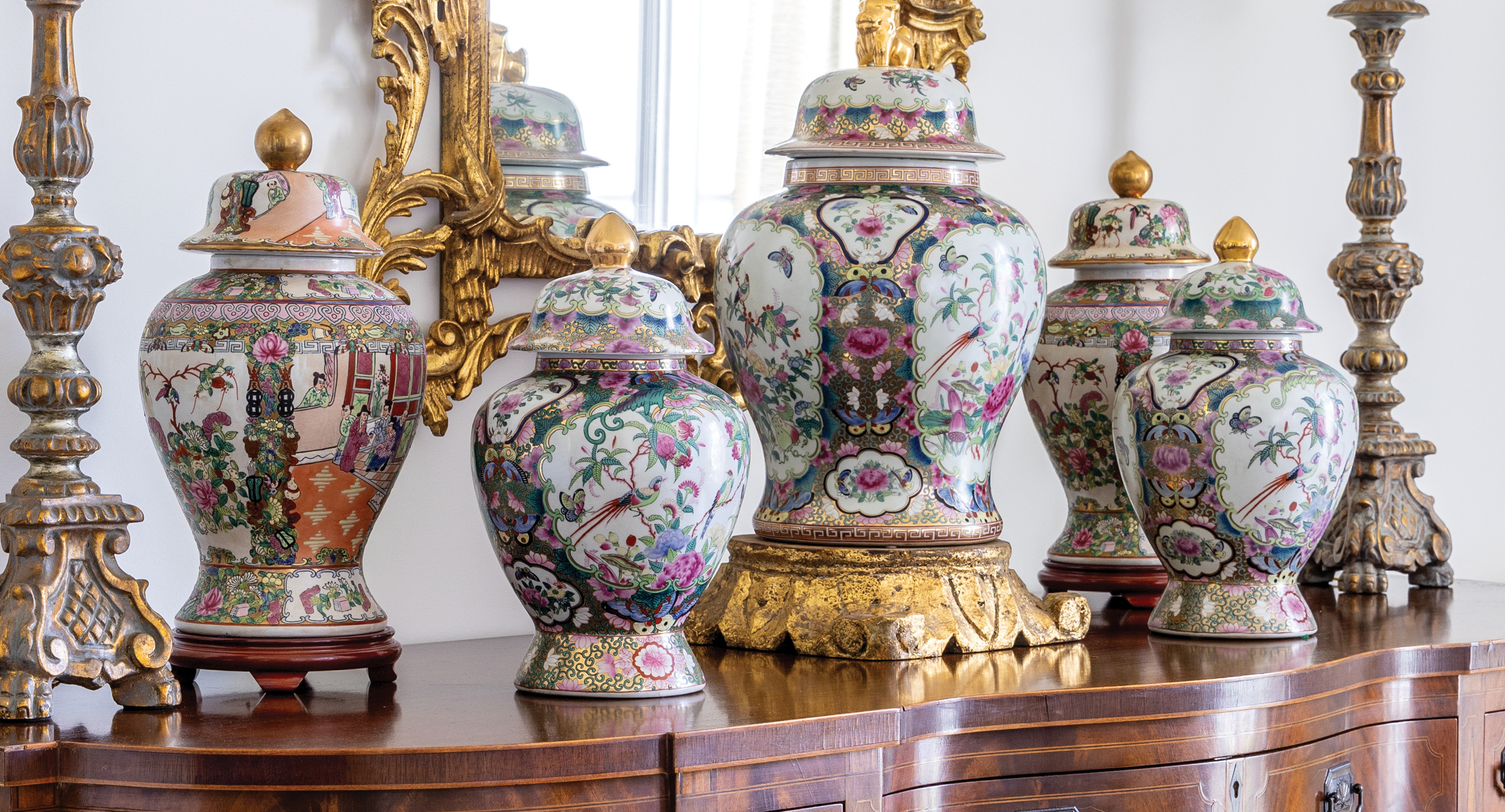
A nineteenth-century French term used to categorize export porcelain by its predominant colors, famille rose, French for “pink family,” applies to porcelain whose primary color is rose-pink with white, green, yellow, and sometimes blue enamels playing supporting roles. Developed around 1720, the famille rose color palette was more chromatically sophisticated than those that preceded it. Because it included white enamel, artists were able to create gradient colors that gave their porcelain decorations a three-dimensional effect, thus allowing for greater design complexity.
 Among famille rose wares, three distinct, yet somewhat similar, patterns emerged. The most beloved then and now is Rose Medallion, which is typically comprised of a central medallion adorned with a bird or tree peony that is surrounded by panels depicting Chinese figures, fruits, flowers, or birds. Slightly less intricate are Rose Canton, which features panels of birds, fruits, or flowers but no human figures, and Rose Mandarin, so named for the Chinese figural scenes that are its chief characteristic.
A mainstay of the Chinese export porcelain trade during the Qing dynasty, which ruled China from the mid-seventeenth century until 1911, famille rose porcelain reached peak quality during the mid-eighteenth century, according to some experts. Its production, however, extended throughout the nineteenth century, during which time its painted decoration became highly elaborate, reflecting the then-prevailing European fashion for maximal ornamentation. Its forms also adapted to changing styles, with large famille rose vases and garden stools becoming desirable during the nineteenth century.
 Although famille rose may have won the hearts of many European and American porcelain collectors, it was not the only polychrome style that was exported to the West. In addition to famille verte, which has green as its dominant color, the respective yellow and black hues of famille jaune and famille noire also found favor. Yet even among such a colorful array, famille rose porcelain would prove to have the rosiest future, garnering an enduring popularity that some might say rivals blue and white.
Need to KNOW
• According to porcelain dealer Paul Vandekar of Earle D. Vandekar of Knightsbridge Inc., the highest quality famille rose pieces were produced between 1725 and 1755. “The earlier examples of famille rose on export porcelain during the Yongzheng period and early Qianlong periods are usually beautifully enameled with slightly soft colors and enamels that are raised on the porcelain and can be felt with the fingers,” he says. “They also still have a prominent Chinese feel with Chinese subjects. Later in the eighteenth century, as the production of porcelain for the export market increased significantly, the quality became slightly poorer and the subject matter became more influenced by European tastes with flowers, often of a European type rather than Chinese.”
• Vandekar says that soup tureens, large bowls, and garnitures of vases are among the most sought-after pieces of famille rose. Additionally, “items such as soldier vases and fish bowls are highly desirable and extremely costly but are rare. Any visit to an English Country House or European palace will allow one to see these objects. Animal figures are particularly attractive and desirable,” he says.
• Be prepared to pay between a few hundred dollars to six figures, depending on the piece’s size, condition, and rarity. “Important pieces such as pairs of soldier vases or fish bowls can be in the hundreds of thousands,” Vandekar says. He also advises that while condition should be considered, “the quality of decoration is also important. It is always better to buy fewer pieces of higher quality than a quantity of lesser pieces.”