
Text: Alice Welsh Doyle
Photography: Eric Piasecki
Styling: Helen Crowther
Experiences abroad can shape you in many ways, and one just may be the architecture you fixate on when planning your dream home. Stan Dixon and Jackye Lanham’s client had spent time in the Cotswolds during her youth, and the charm of the region and British architecture remained imbedded in her mind’s eye. Dixon, who had spent time studying in England as an architectural student, and Lanham, a professed Anglophile, easily dialed into that aesthetic during the design process.
British Architecture Inspires a Dream Home in Atlanta
British Architecture Inspires a Dream Home in Atlanta

British Architecture Inspires a Dream Home in Atlanta

British Architecture Inspires a Dream Home in Atlanta

British Architecture Inspires a Dream Home in Atlanta
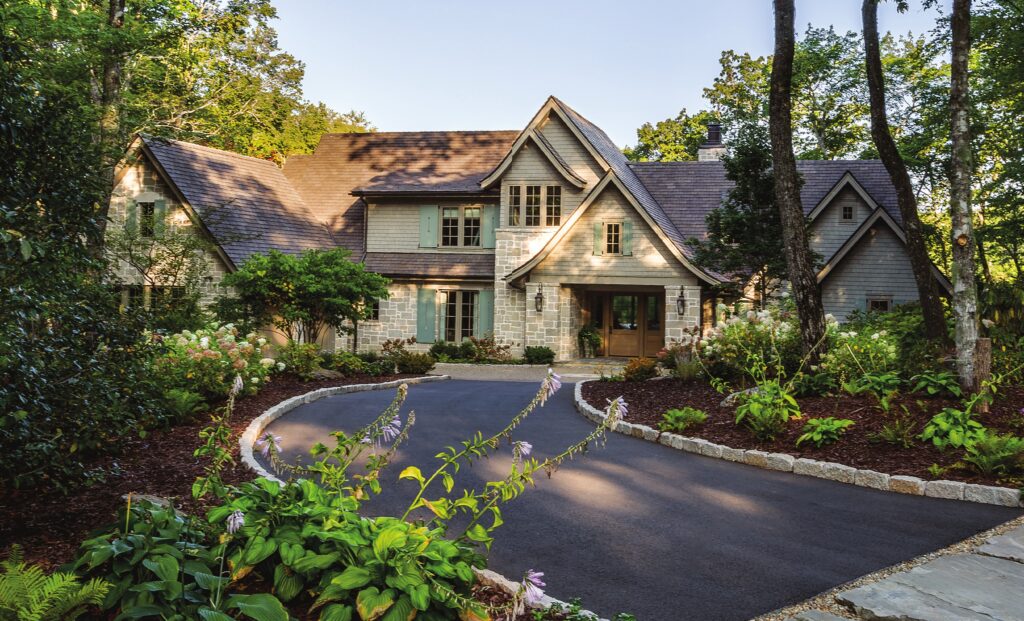
 The inspirational roots begin to shine through in the facade, which shows off a handsome pair of chimneys placed between symmetrical gables that frame the front door. The exterior materials also reference a British manor house with a pairing of limestone and a unique brick that has a mortar wash poured over it—both provide a warm ocher masonry finish.
The elegant casement windows with timber frames and a Vermont slate roof complete the picturesque appeal. The inside of the house further reveals English tropes, many inspired by inventive, celebrated 20th-century British architect Edwin Lutyens, especially his design for Castle Drogo. The influences include the coffered ceiling details, limestone mantels, and the exquisite European oak custom kitchen work surface.
“Lutyens had these big tables in the center of the kitchen, and we took cues from that; this has the feel of a table, but it’s a comfortable 36-inch height for kitchen prep,” says Dixon. “It also adds warmth and gives the kitchen a more collected feel along with the timber casement windows; not everything matches.”
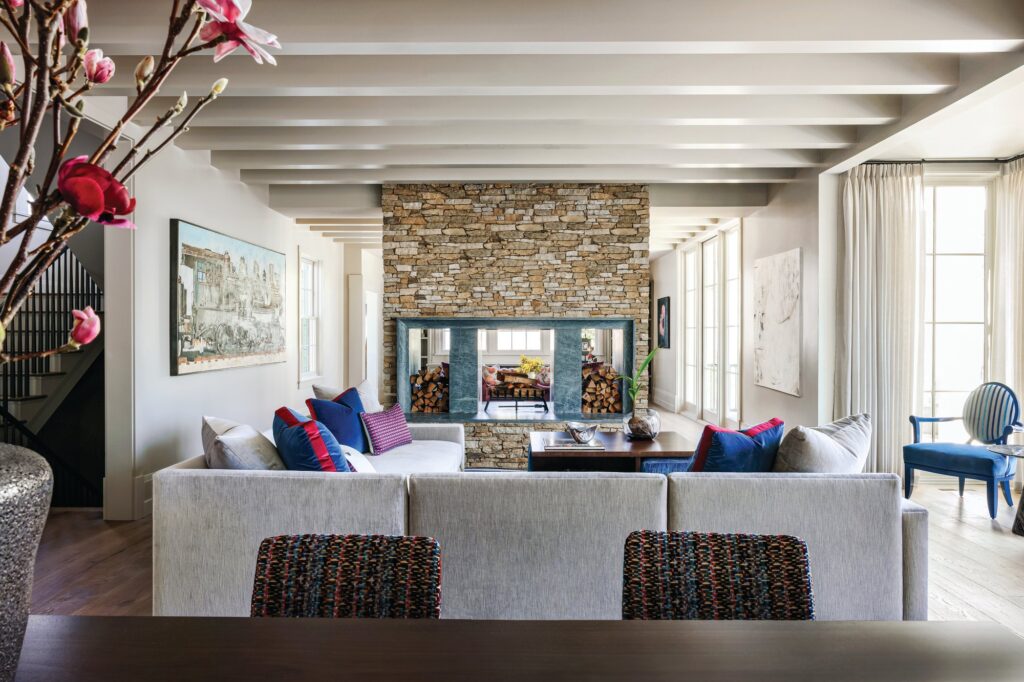
For the interiors, Lanham was fortunate to incorporate the client’s fine collection of antique furniture and artwork (the couple had previously worked with the late Dan Carithers). “We took what they had and enhanced it, and we softened up the heavier Tudor-style furniture a bit,” says Lanham.
For the palette, the designer put historic English country houses aside with their often-dark colors. Instead, she leaned into her client’s favorite quieter shades of caramel, nougat, faded mustard, and tones pulled from the French oak floors intertwined with brushstrokes of pale blue. The dining room wallcovering is a bit of a departure from the expected colorway of a de Gournay design; the custom finish includes muted blues and greens on a warm tea-stained-like neutral.
Since this is a young family, Lanham did not want anything to feel heavy-handed or too weighty. In that regard, she introduced some unexpected touches to keep any space from feeling too stuck in the past. For example, she designed a fanciful custom bench in a lively teal finish for a connecting space, which could have been just utilitarian.
“Putting a table there just seemed boring, so I thought about those houses in Italy with open breezeways, and they often include a painted bench,” says Lanham. She pulled the color from her client’s impressive chinoiserie screen mounted behind and completed the vignette with a pair of painted wooden floor lamps in the same hue.
“This space looks out on the backyard, and the bench makes such a dramatic statement when you are on the lawn looking in,” says Lanham. The designer also injected some liveliness in the light fixtures chosen for the home. In that same connecting space, Lanham found globe pendants while doing a deep dive on the Internet.
“They are indicative of a Moroccan lantern, but in a more updated interpretation,” she says. For the study, the designer found a turn of the century tole two-tiered chandelier. “It is in that pretty faded ocher color, and it’s very reminiscent of Colefax and Fowler,” says Lanham.
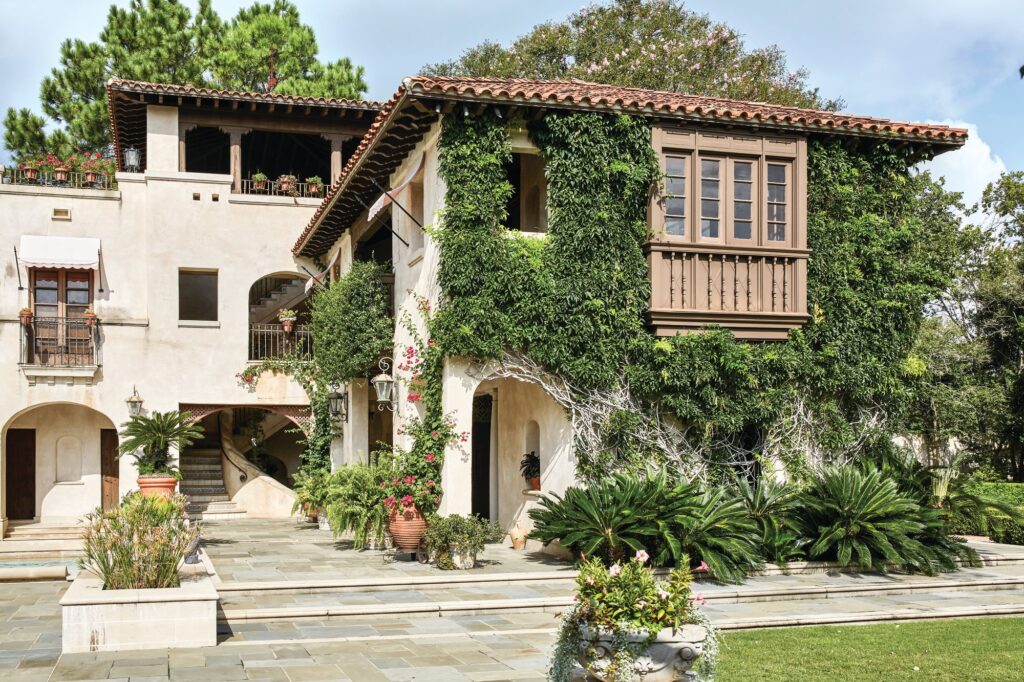
The love affair with British design continues on the back of the home, and it may be just as compelling as the front—it’s certainly a toss-up. The long loggia is set off by a series of Voussoir arches. “These are very English, and you often see them on ecclesiastical and academic buildings,” explains Dixon.
The detailing on the top of each arch seems to melt into the column portion, and Dixon admits it was one of the most difficult design elements. For the floor of the loggia, the team was able to source reclaimed Cotswold stone that came from gardens in England.
This space connects to a pristine grass lawn anchored by four large boxwoods and surrounded by a crushed stone courtyard and pathways designed by Atlanta landscape architect John Howard. Every last detail is artfully orchestrated to capture that English sensibility, which has attracted lovers of design for centuries. Like Lutyens’ Castle Drogo, this Atlanta home is certainly one for the ages.