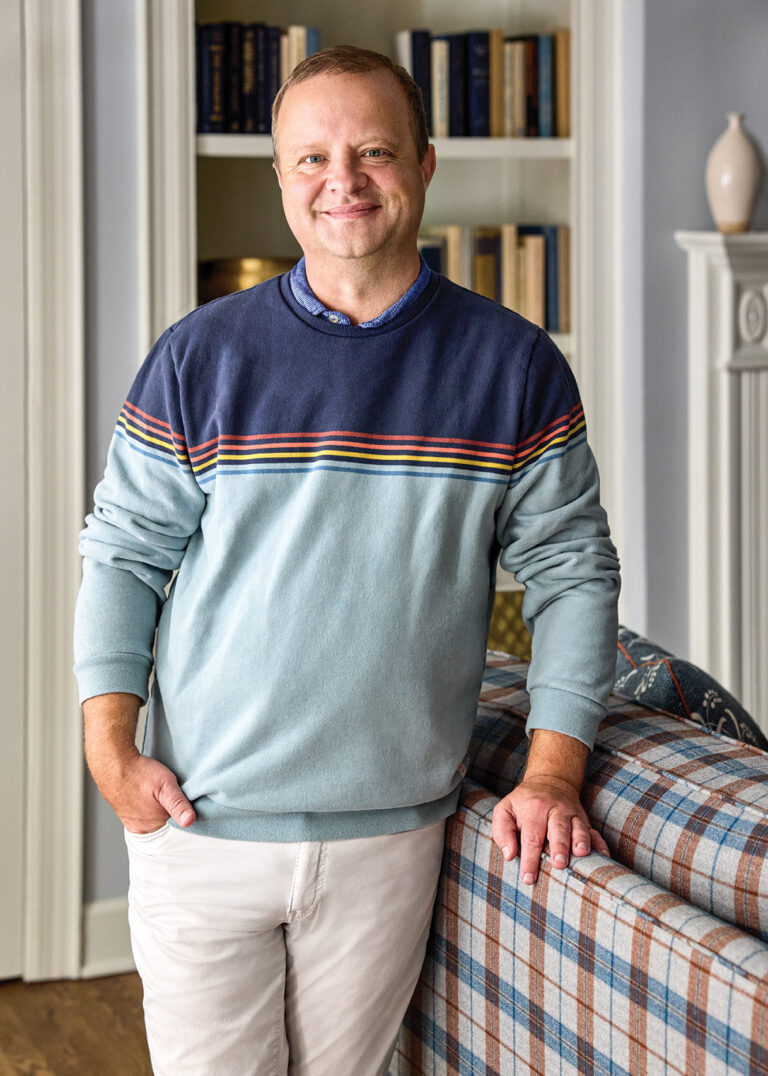
Text: Karen Carroll
 Southern Home (SH): We often begin by asking about the path to becoming a designer—yours seems almost predestined [Alexa started working with her father, legendary designer Mark Hampton, when she was 13], and you answered pretty definitively in the opening pages of your new book, Alexa Hampton: Design, Style, and Influence (Clarkson Potter, 2023). Given you’ve tackled this question countless times, we’ll give it a twist: If you hadn’t become a designer, what would you have been?
Alexa Hampton (AH): I think about that a lot. The fact was being a designer wasn’t handed to me, but the opportunity was. However, 10-year-old Alexa might have dreamed of being an artist or a bad fashion designer. Maybe I’d be a movie critic—I studied film, modern culture, and media at Brown [University], and I’m totally obsessed with movies. I’m going to have to get that answer tattooed on my wrist so I can remember it.
SH: This, your third book, is such an intriguing combination of personal anecdotes and memories, essays on your design heroes, and a tour of the fascinating evolution of your apartments through the years. What prompted you to write this one now?
AH: I owed my publisher another book and had successfully dodged them for a decade, bobbing and weaving and hiding behind doors. Many of the most exciting projects I’ve done in the last 10 years I’m not allowed to publish for security and privacy reasons. But I did want to share what I’m doing, the progress of my career, as well as tell a story. In our small design world, we all know Mark Hampton, so in many ways, people know my story. But there have been these moments, these personal, seismic moments, like the Givenchy sale in the early ’90s, that I will never get over. I was in my early 20s, and it changed my life. I’d thought of proper French design as formal and beautiful but so improbable in which to live, and then I saw how he did it and another level went off in my head. And for Mark Hampton fans, I was very excited to give them photos of my parents’ New York apartment and country house, which had never been photographed digitally. I wanted this book to share some of the references and influences that are always lingering in the back of my mind.
 SH: How do those references manifest in your design projects?
AH: I don’t sit down and say, “I’m going to rifle through my inspiration or channel the zeitgeist.” A lot happens subliminally. A huge piece of the puzzle is the homeowner—the client is like the hand of God touching the hand of Adam. They start telling me something, and it creates the spark that starts a fire. Ok, yes, that makes me think of this, and let’s look at these images; or, ok, I’m totally where you are and want to play with those things. And then some of the elements swirling around in my brain come into focus. I’ll never not remember a great curtain I saw in Sweden. That sounds both random and specific, but there are also the design libraries I’m looking at all the time or Pinterest. They’re just another tool in the toolbox, but they’re power tools. I think through it all—it can’t only be, “Oh, I’m feeling a stripe today.” I’m forever a student, and as a design professional, I can have talent, but I also have to have mastery. I call it the Julie Andrews approach to design: “Once you know the notes to sing, you can sing most anything.” But mastery is a must before you can make such bold statements.
 SH: What are some of the design elements that hit the right note for you?
AH: My goal is harmony. In the past five years, I’ve come to realize that harmony is real. I can make a beautiful room, no question, but I want to make it where it transcends, where you don’t see the work. I love symmetry, balance, and proportion. The combination of colors, the frequency of which the color appears, how it plays with others, and how they spread across a room, are extremely important. I can’t have all the color clustered on one side of the room.
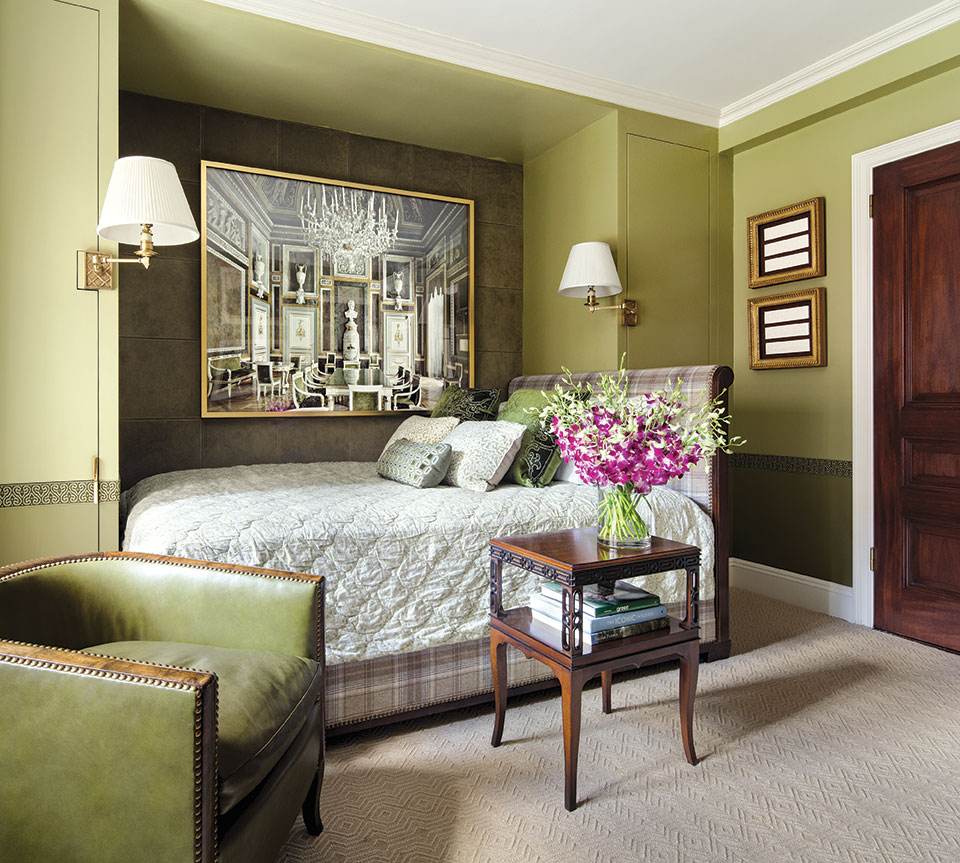
I love visual punctuation, so maybe if everything is symmetrical, I have one moment of very planned asymmetry that becomes dramatic. For some years I’ve been having so much fun using large-scale photographs by Massimo Listri and Celia Rogge that show other rooms within the room. It becomes almost cinematic. And I love anything neoclassical—antique busts are my talismans.
SH: Your love of the neoclassical reminds us of that recent meme about how many times a day men think about the Roman Empire. We’re guessing you think about it a lot, too.
AH: Yes, supposedly women never do, but I’m thinking about it all the time! Neoclassicism is so hopeful. It’s the expression of people reaching for an ideal, and I appreciate that. It’s attempting to impose order on chaos, whether in politics or architecture. What a wonderful impulse.
SH: You also mentioned you’ve spent a lot of time pondering harmony in the last few years. What prompted that reflection, and what conclusion have you come to for reaching it?
AH: Maybe it’s a reflection that I’m old enough to be confident in the truth that lots of things about design are subjective, but harmony is a real thing and absolutely achievable. It’s when the pieces stop pulling out from the room, and you live in an interior or look at a facade, and it feels right. Nothing sticks out like a sore thumb because everything works together.
 SH: However, doesn’t every room need a best actor?
AH: I prefer the word lead, rather than best, because some of the smallest moments in a room can be the most dazzling. But to keep the metaphor going, the sofa is one of the leads, because of its size. The color of the room is a lead. Lighting, obviously. When we look at a movie set, we focus on the visual, but truly successful interiors engage all the senses. If I’m talking with a client who doesn’t want curtains, I can explain not only are they pretty, but also the quality of sound imposed in a room once the curtains go up is very special. Touch can come in the tactile quality of the fabrics or the fill in a comfortable chair cushion. Whether it’s the candles you light or the music you choose, everything contributes.
SH: What’s inspiring you lately?
AH: My new office, which is taking forever. This is my first office that wasn’t Mark Hampton’s before, but you know whose it was? Arthur Smith’s, Billy Baldwin’s business partner! Being my father’s daughter, I also feel very much like the industry’s daughter— although now I’m more like the older aunt—so I appreciate being a steward of Smith’s space. It’s in a town house, and the communal work area is in the kitchen. Everyone has a desk but me, because I’m going to be working on the sofa with my laptop or at the conference table. COVID changed us, and I want my work to happen in a domestic space. I feel like that’s a revelation.
SH: You also design a number of product collections—from furniture and fabric to mantels and almost everything in between. Is there anything you long to put the Alexa Hampton imprint on that you haven’t yet?
AH: Dinnerware. Let’s manifest that. I need a great Southern patron. Sign me up, because I know eating, I know pretty, and I love setting a table.
SH: Finally, as a dyed-in-the-wool New Yorker, what interests you most about Southern homes?
AH: First of all, I think God meant for me to be a Texan and something happened along the way. I’m loud, funny, blonde, tall, and love Tex-Mex. The phrase Southern home is almost a redundancy because Southern is home. It’s about getting it right; it’s about welcome and hospitality. I long to be that woman who is the consummate hostess, where everything is beautiful, the food tastes good, and there’s a properness to it. I feel very aspirational about the Southern home, but until then, I’m a New York City girl.
 Ask Alexa
If I could design a house for anyone, it would be: Oscar Wilde would be great, but he’d probably be a lousy client, so I’ll go with The White House.
I’m always on the hunt for: Antique helmets; chairs; something that puts a smile on my face—and that could be a cheeseburger.
Every room needs a touch of: Black. I love an ebonized piece of furniture and basalt.
Favorite color combo: Pink, purple, orange. My dad hated purple, but he’d get over it and would think my current bedroom is fabulous.
If I won the lottery tomorrow, I’d buy: First of all, I intend to win the lottery—I’ve got my ticket, and I have a plan. I’d buy a Mercedes Sprinter van and kit out the interior to look like the Orient Express. That’s how I’d get hither and thither. I’ve also made notes of what kind of houses I’d buy and who’d decorate them. Markham Roberts would decorate one, and I’ve got room for Stephen Sills.
Little luxury I can’t live without: A very elaborate manicure every two weeks—silk wrap and gel.
You’ll never see in my work: At one time I’d have said mohair, but some are growing on me. Now that’s a terrible sentence, isn’t it? I’ll say a black-and-white awning stripe—a mohair black-and-white stripe would be really bad.
When or where I’m happiest: With my family and dogs, wherever that may be, but definitely lounging. Otherwise in the bathtub, because I come up with great ideas there.
Hotel I’d move into: Le Bristol in Paris
Best piece of decorating advice: If you know what you like, selfishly pursue that. If you love purple or pink, go for it. By all means hire a designer to help, but don’t torture yourself trying to like something you don’t like.