Text: Jennifer Boles
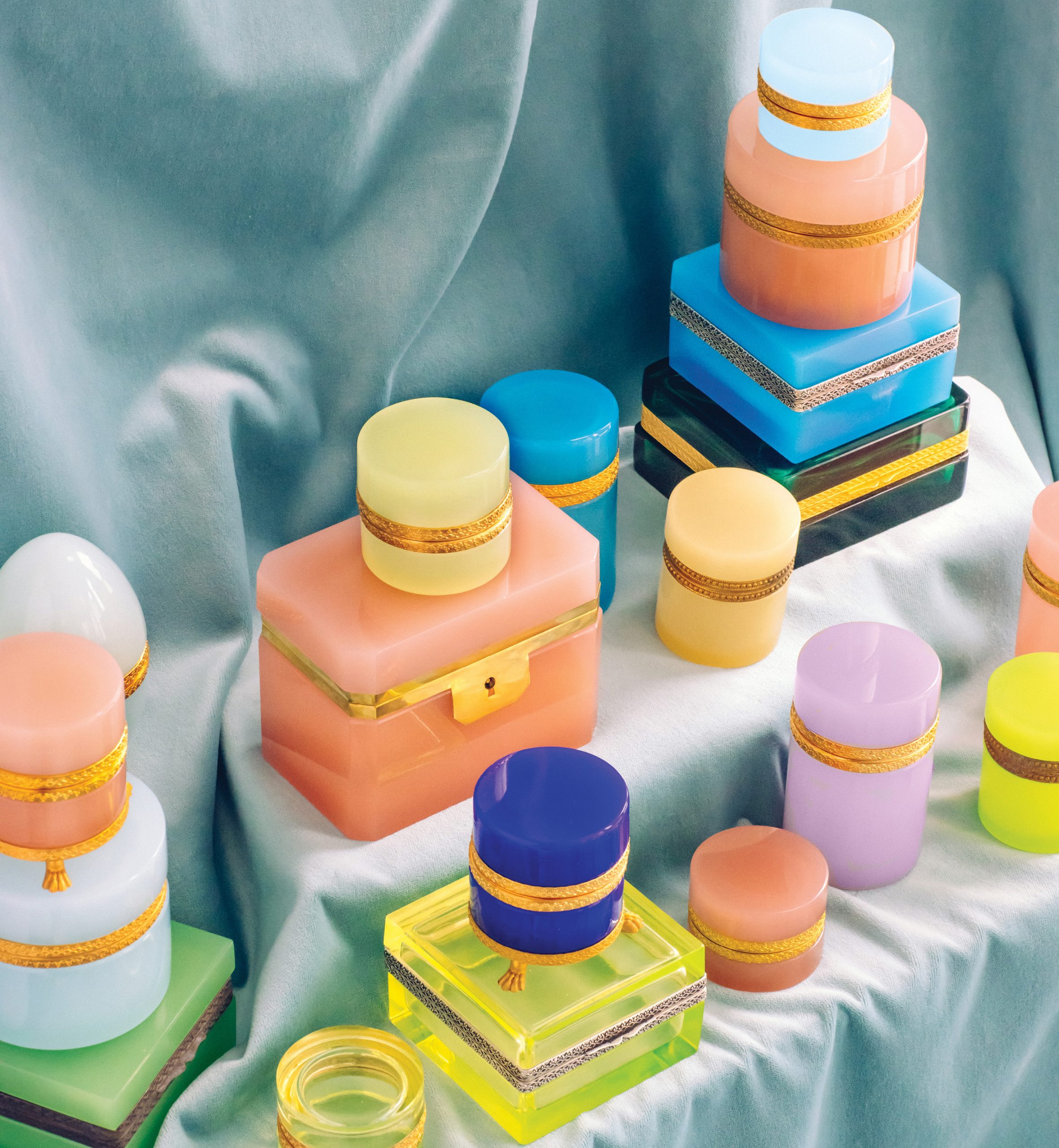
In the 18th century, European glassware rarely deviated from tradition, meaning that most glass produced during this time was clear and minimally embellished. But as tastes began to change around the turn of the 19th century and rich colors crept back into fashion, some of France’s leading cristalleries, such as Saint-Louis, Le Creusot, and Baccarat, set out to create a different style of decorative glass that better reflected the times. Thanks to their efforts, a new type of vibrant glassware, later known as opaline glass, was introduced, quickly taking France by storm and becoming the epitome of opulent 19th-century French style.
Unlike the colorful examples that would soon be produced, the earliest French opaline glass was milky white and semiopaque, an effect that was the result of adding bone ash to a lead-crystal mixture. When it was held to the light, however, it had fiery red undertones similar to those of an opal, a quality that led to it being christened cristal d’opale, or opal glass. The term “opaline” was a later development, which some believe was coined by Baccarat in the 19th century, while others attribute it to 20th-century French collectors.
 A range of striking colors followed shortly thereafter, courtesy of the cristalleries’ experimentations with introducing metallic oxides to the crystal mixture. A purplish-pink iridescent hue known as gorge de pigeon, or pigeon’s breast, was achieved by adding gold and pewter dust to the mixture, while amber yellow was another sophisticated shade sometimes seen. Incidentally, both colors were phased out by the 1830s due to the costliness and difficulty of creating them. Other early to mid-19th-century shades included lavender and turquoise, with white continuing to be produced, too. It should be noted that opaline glass made in the first half of the century had a translucency that was later abandoned in favor of a more opaque finish.
Hand-enameled decorations were another unique feature of some opaline glass, particularly those pieces produced by Baccarat. Its star artisan, Jean-Francois Robert, was a renowned decorative painter who perfected the technique of using translucent enamels to create painted designs on opaline glass, an effect not unlike that of painted porcelain. Scenes of nature were popular as were classical motifs, both of which were characteristic of the then dominant, neoclassical Empire style. Opaline glass forms were typically neoclassical as well and included ewers, baluster-shaped vases, and boxes, which were often set with classically inspired gilt-bronze mounts.
 French opaline glass reached peak popularity by the 1850s and ’60s, with consumer desire for pieces so great that less-august French factories began producing the glass, too—a development that eventually led to a gradual decline in overall quality. Because the translucency of early opaline glass was technically difficult to achieve, many factories opted instead for glass that was more opaque, while forms tended to be less intricate than those crafted decades earlier. And while the range of colors shrank to primarily blue, pink, and green, many of the pieces produced in the late 19th century were nonetheless enticing.
Although production of it mostly ceased by 1890, opaline glass remained a popular collectible, particularly among those with an affinity for 19th-century style. In fact, one of the most enthusiastic collectors of the glass also happened to be a towering figure of 20th-century design: legendary French decorator Madeleine Castaing, whose fondness for turquoise-blue opaline glass became a hallmark of her work, helping to introduce a new generation of collectors to the colorful charm of opaline glass.
 need to KNOW