

Seeing the importance of better relating both structures to their surroundings, the team quickly developed a plan of action. “Because the guesthouse was in desperate need of repair, we chose to tackle it first,” Norris says.
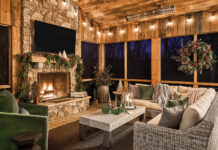
“Our decision gave the owners a place to live in while the main house was under construction.” As a result, this charming, backyard retreat now resembles a bygone carriage house and offers a wonderfully private setting for overnight guests.
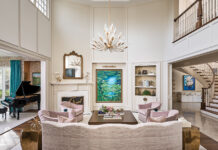
To create better circulation in the main house, the architects chose to reverse the main staircase—an ingenious move which not only connected the front and the back of the house more succinctly, but also allowed for the addition of a new master bedroom on the second floor. “The original stair was completely enclosed in a dark, unpleasant spot,” Spitzmiller recalls. “After we removed the walls of this enclosure, we replaced them with a handsome wooden balustrade and a handcrafted, period-sensitive starter newel. Now the staircase stands as one of the premiere architectural ornaments of the house.”
Other changes, such as combining the kitchen, family room, and functional mudroom into one unified space, greatly improved the livability of the home. “We also visually tied these areas together by using bluestone flooring throughout, intermixed with a wooden inlay in the mudroom,” Duffy says. “As an added bonus, this interplay of materials keeps the family dogs cool when they are resting.”
By retaining much of the original plastered walls and oak flooring in the living room, library, and dining room, the design team seamlessly merged existing and new elements. As a finishing touch, they added flush, tongue-and-groove paneling in some rooms for an aged, well-established effect. “The house and guesthouse look like they’ve never been renovated,” says Norris. “Instead, they convincingly appear as if everything has always been this way.”